The Battle of al-Qadisiyyah
The Battle That Opened the Gates of Persia
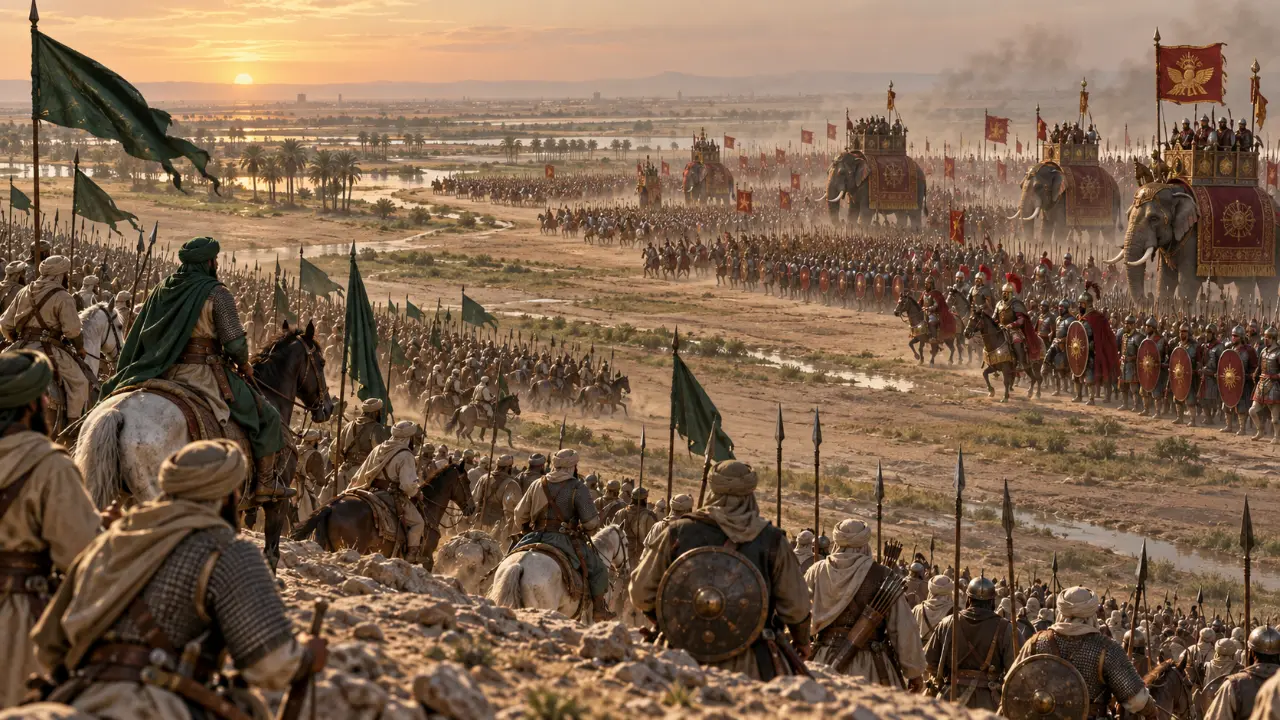
In the west of the ancient world...
Muslims were crushing the Roman forces at Yarmouk.
But in the east...
there was another empire, no less powerful or formidable.
An empire that ruled Iraq and Persia for centuries...
The Sassanid Empire.
Its army was well-trained...
Its leaders were experienced...
And its most fearsome weapon...
War elephants.
And on the borders of Iraq...
The Muslim army stood ready for battle.
An army that was neither the largest in numbers...
nor the best armed...
but one that carried a faith that knew no retreat.
Its commander was a sick man who could not go down to the battlefield himself...
but he led one of Islam’s greatest battles from atop a palace overlooking the battlefield.
He was Sa’d ibn Abi Waqqas, may Allah be pleased with him.
On the other side…
stood the great Persian commander Rustam Farrokhzad.
He knew that losing this battle…
would not merely mean the defeat of an army…
but might signify the beginning of the end for the Persian Empire itself.
This is…
the story of the Battle of al-Qadisiyah.
Why did the Battle of al-Qadisiyah take place?
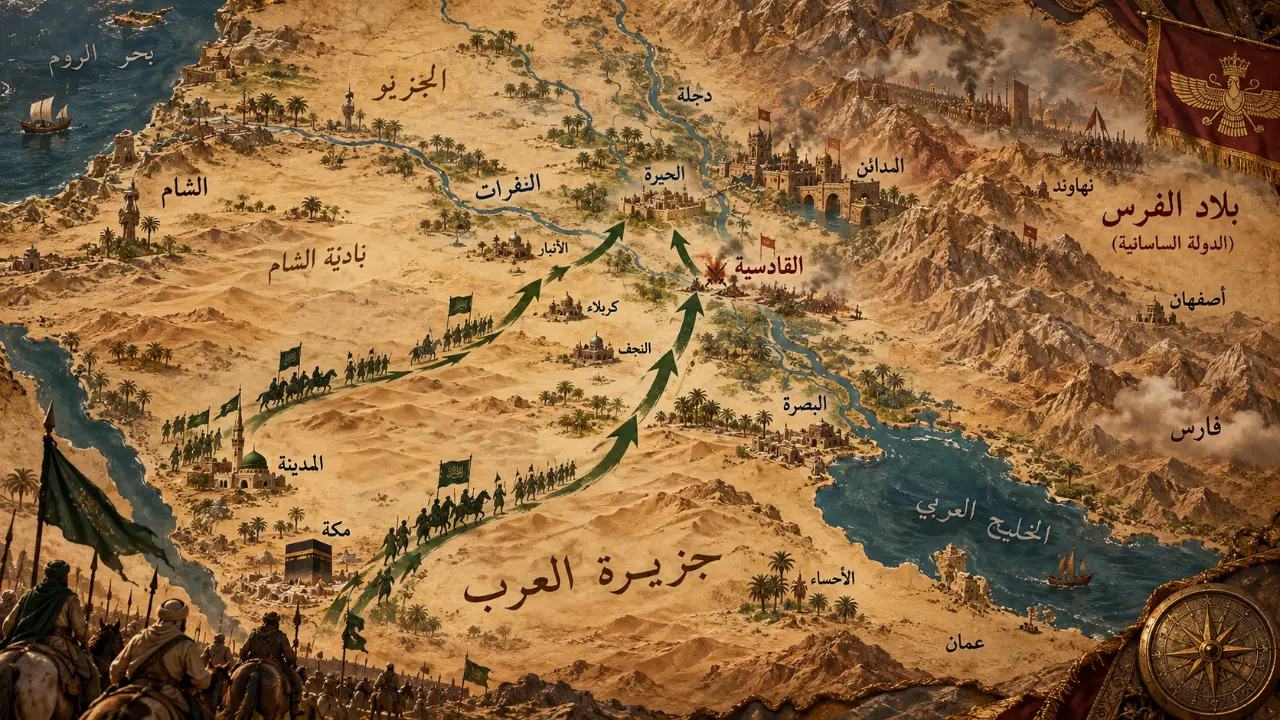
After the death of the Prophet Muhammad ﷺ, the Islamic state faced the Wars of Apostasy within the Arabian Peninsula.
And after Caliph Abu Bakr al-Siddiq reunified the Peninsula...
Islamic armies began to move beyond its borders.
Some armies headed toward the Levant...
while others headed toward Iraq.
At that time, Iraq was part of the Sassanid Empire.
It had wealthy cities...
vast agricultural lands...
and powerful Persian forces...
alongside local Arab and Persian rulers.
The Muslims achieved early victories in Iraq during the reign of Abu Bakr...
But the major confrontation did not occur until the reign of Caliph Umar ibn al-Khattab.
Umar realized that the clash with Persia was not merely a series of border raids...
but a conflict with a superpower.
And so he began preparations for a decisive campaign…
a campaign that would shift the conflict from sporadic skirmishes…
to a decisive showdown.
And thus…
the road to the Battle of al-Qadisiyah began.
The Two Commanders: Sa'd ibn Abi Waqqas and Rostam Farrokhzad
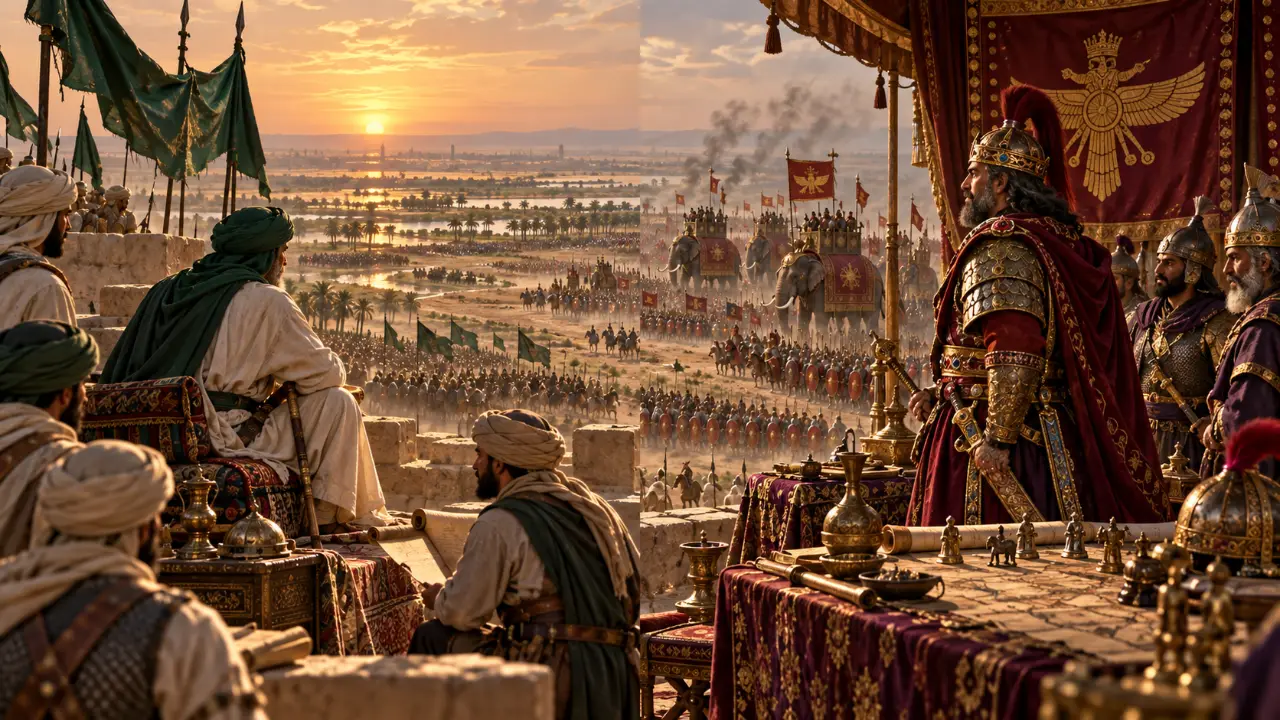
Caliph Umar ibn al-Khattab chose the venerable Companion Sa’d ibn Abi Waqqas to lead the Muslim army.
And Sa’d was no ordinary commander.
He was among the earliest to embrace Islam...
and one of the senior Companions...
and a figure of great stature among Muslims.
But when he arrived at Al-Qadisiyah...
he was ill, and his feet and back were in pain.
It was even said that he could neither ride a horse nor dismount to fight as usual.
So he directed the battle from a palace or an elevated vantage point overlooking the battlefield…
transmitting his orders to the commanders below.
As for the Persians…
were led by the famous commander Rustam Farrokhzad.
A statesman and a warrior in one…
who understood the gravity of the situation all too well.
The Sassanid Empire at that time was not at its strongest.
Internal conflicts had weakened it…
and the throne had been shaken more than once...
But it still possessed a massive army...
and heavy weaponry...
as well as long experience in warfare.
And Rustam knew that the Battle of al-Qadisiyah could determine the fate of all of Iraq.
The Land of Al-Qadisiyah... and the Battlefield
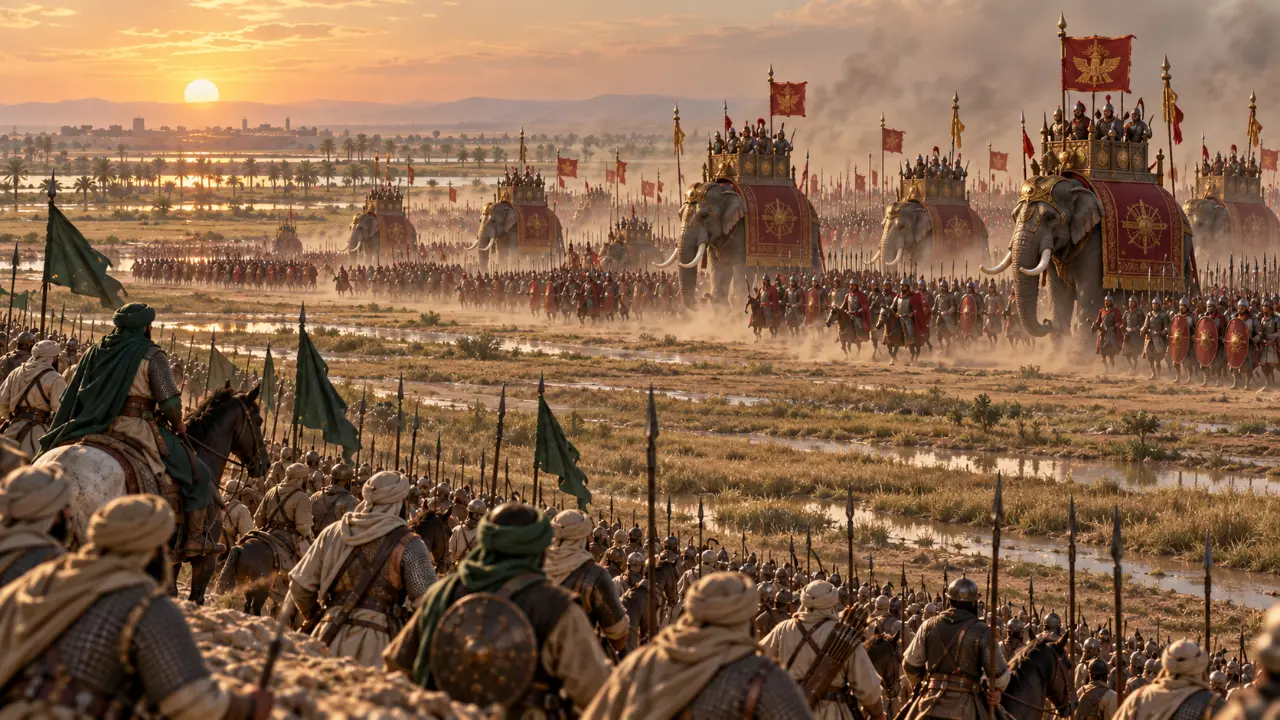
Al-Qadisiyah is located in an area near Al-Hira, on the outskirts of Iraq.
It was a suitable battlefield for two large armies.
Open plains allowed for the movement of troops...
But it was also close to water sources, canals, and irrigation ditches...
which meant that movement, organization, retreat, and attack were all tied to the geographical terrain.
Each army chose its position...
and the ranks were organized.
According to the most well-known accounts, the Muslim army was outnumbered by the Persian army...
but it was more flexible.
As for the Persians...
they relied on the sheer weight of their army...
their large number of infantry...
and their armored cavalry...
and the most fearsome weapon of all...
the elephants.
The mere appearance of the elephants on the battlefield was enough to unsettle the cavalry...
and instill fear in the hearts of many fighters who were unaccustomed to seeing them in battle.
From the very beginning…
the Muslims understood that defeating the Persian army would not be possible…
as long as the elephants moved freely across the battlefield.
Before Combat: Negotiations and the Message of Islam
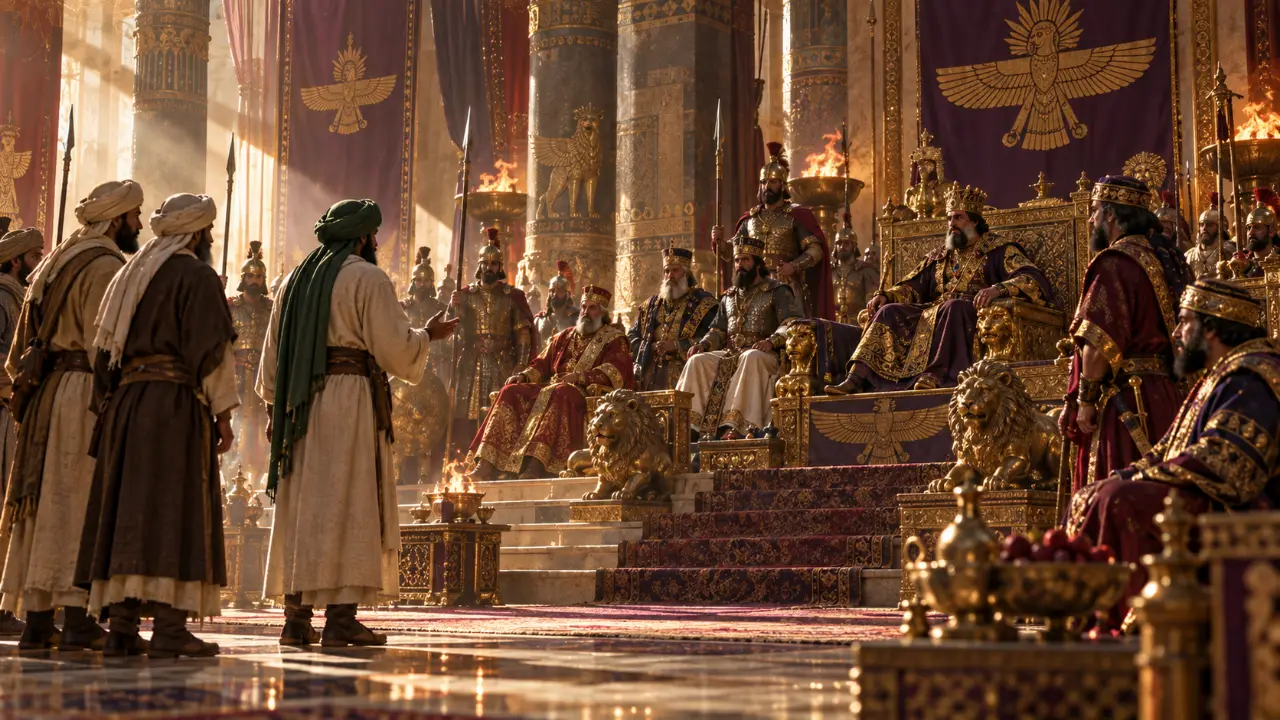
Before the battle began...
A series of encounters took place between the Muslims and the Persians.
Sa’d sent delegations to Rustam.
The goal was clear:
To invite the Persians to Islam...
Or to peace and the payment of jizya...
or to fight if they refused.
Among the most famous accounts in the sources...
is the scene in which the Muslim envoys approached the Persian leaders dressed in simple garments...
but with powerful words.
They were not dazzled by the splendor of the palaces… nor by the Persians’ gold…
nor by the majesty of the throne.
And the message they conveyed was clear:
“We have come to lead people away from the worship of creatures to the worship of the Lord of all creatures…”
Rab’i ibn ‘Amir entered Rustam’s council chamber wearing simple clothes, carrying a sword and a shield, and riding a small horse.
He rode his horse over the edges of the silk rugs and carpets adorned with gold,
then dismounted and tied it to one of the gold-embroidered cushions after tearing it open. The guards said to Rabi’: “Put down your weapon.”
Rab’i ibn ‘Amir: “I did not come to you on my own; I came only when you summoned me. If you leave me like this, I will return.”
Rustam (to the guards): “Allow him to enter.”
So Rabi’i approached, leaning on his spear as he walked over the gilded rugs and cushions, tearing most of them out of contempt for worldly adornments. When he sat down, he sat on the ground and did not sit on their cushions,
and he said: “We do not care for sitting on these adornments of yours.”
“Allah has sent us forth to bring whoever He wills out of the worship of creatures to the worship of Allah, out of the narrowness of this world to its vastness, and out of the injustice of other religions to the justice of Islam,”
calling them to Islam, the jizya, or battle—to attain Paradise or victory. The full details of this dialogue and the exchanged remarks can be found in the cited reference.
When Rustam requested a delay to deliberate and consult his people, Rabi’ informed him that the Sunnah of the Prophet ﷺ dictates that enemies be granted no more than three days,
giving him clear options once that time had elapsed. When Rustam expressed surprise, asking if he was the leader of his people,
Rab’i replied with his famous statement:
“No, I am merely a man of the army, but our private affairs take precedence over our public ones.”
Day One: The Day of Armath
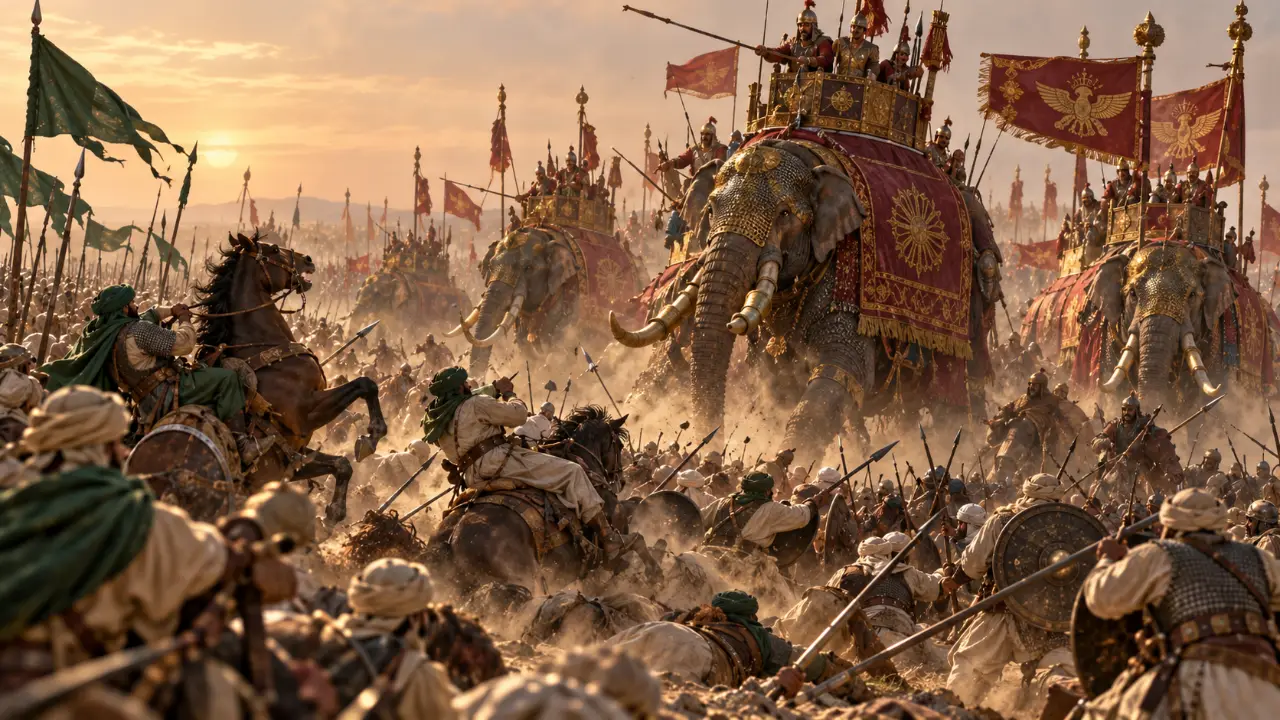
The battle began.
On the first day...
The Persians unleashed their military might on the battlefield.
The ranks advanced...
And the elephants moved forward.
Their impact was terrifying.
The Muslim horses were thrown into panic at the sight of them...
And some ranks retreated under the pressure.
The fighting intensified between the two sides.
It was not merely psychological shock...
Rather, the war elephant itself posed a serious breach point.
It advanced, accompanied by the warriors...
Opening gaps in the ranks...
And forcing the horses to retreat.
And yet...
The Muslims held their ground.
Fierce duels and clashes ensued...
and each battalion tried to hold its ground.
The first day ended in a stalemate…
but the Muslims emerged with a clear lesson:
The biggest problem was not just the Persian army… but the elephants.
Day Two: The Day of Aghwas
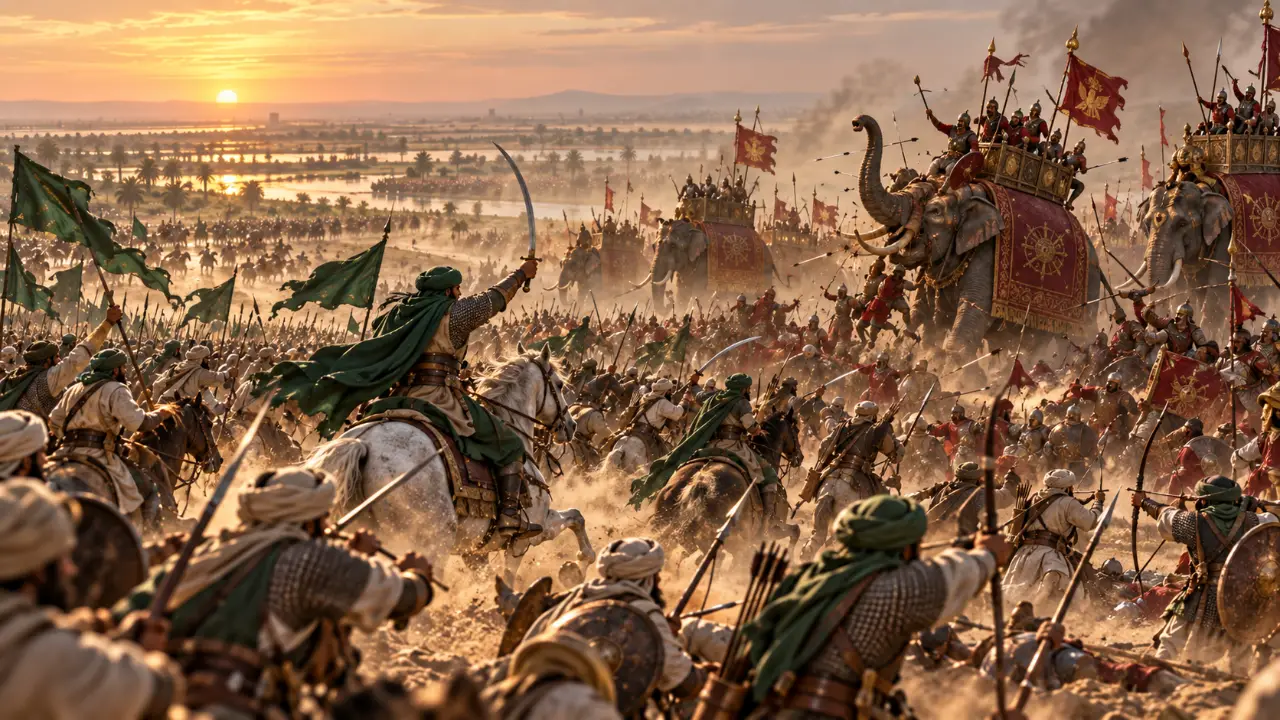
On the second day, supplies arrived for the Muslims.
Among the most famous of those who arrived that day was Al-Qa’qa’ ibn Amr al-Tamimi, whose name is associated in the accounts with a fierce fighting spirit and a powerful psychological impact.
The reinforcements arrived in waves...
until the Persians came to believe that the Muslims’ reinforcements would never cease.
And during the battle...
the Muslims began to develop a strategy for dealing with the elephants.
Instead of confronting the massive animals directly...
they focused on the rider above it...
and on its eyes...
and on the belts and cloaks covering it.
Accounts note that Al-Qa’qa’ and other fighters played an important role in encouraging the Muslims to target the elephants themselves.
The fighting intensified.
On that day...
the balance of the battle began to shift slightly.
The elephants were no longer victorious as they had been at the start...
and the Muslims no longer viewed them as an invincible weapon.
An idea began to take shape:
If the elephants fell... the Persian army’s spirit would be broken.
Day Three: The Day of Amas and the Night of Al-Hirir
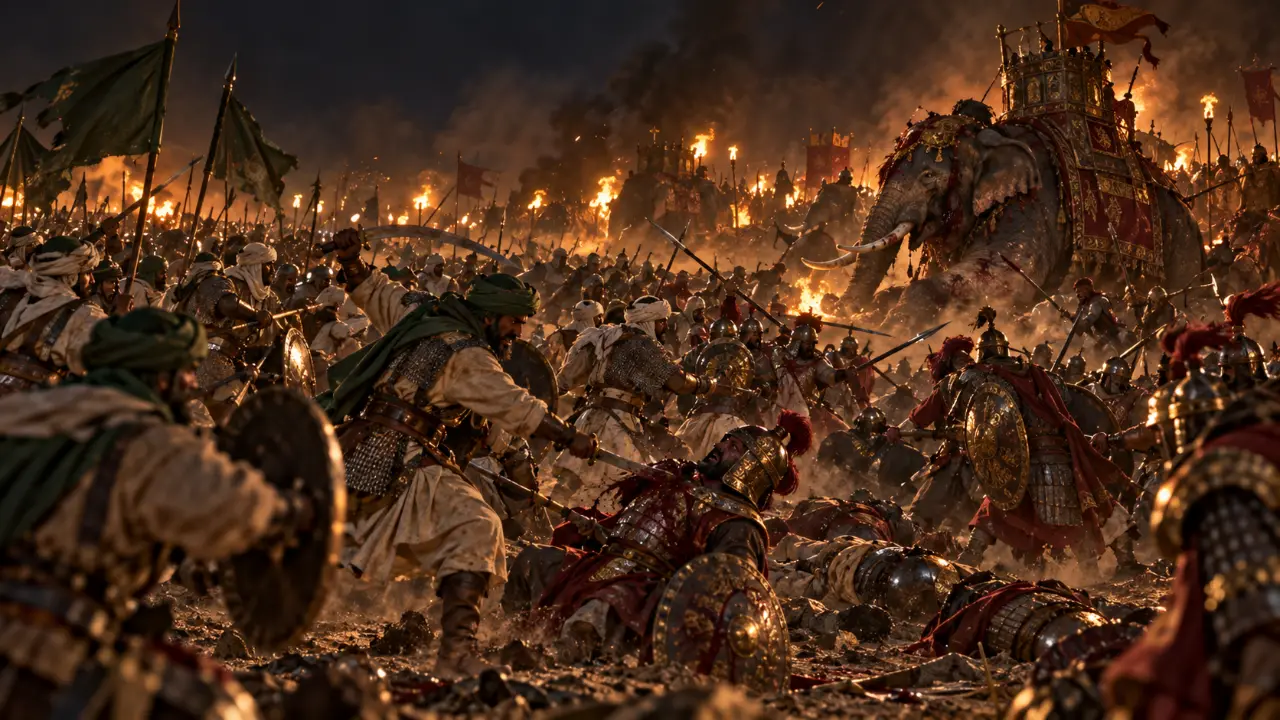
The third day arrived...
It was one of the fiercest days of the Battle of al-Qadisiyah.
The fighting had intensified since morning...
The ranks intermingled...
And casualties mounted on both sides.
On this day...
the Muslims managed to strike the large elephants and drive them off the battlefield.
And this is when the most critical turning point occurred.
For when the elephants became unsettled...
the Persian forces attached to them became disoriented...
and the entire scene changed.
The horses, which had been panicking at first...
began to regain their footing.
And the fighters, who had been battling under the pressure of the elephants...
breathed a sigh of relief for the first time.
But the fighting did not stop at sunset.
Rather, it continued into the night...
into a night known in historical sources as the “Night of Purring.”
It was so named because of the intensity of the sounds…
the mingling of breaths…
and the clang of weapons…
until the entire night seemed like a continuous moan and purr.
There was no real respite.
It was a night of immense attrition.
Each side tried to hold out longer than the other.
And every fighter knew that the coming morning...
might be the decisive one.
Day Four: The Fall of Rustam... and the Collapse of the Persians
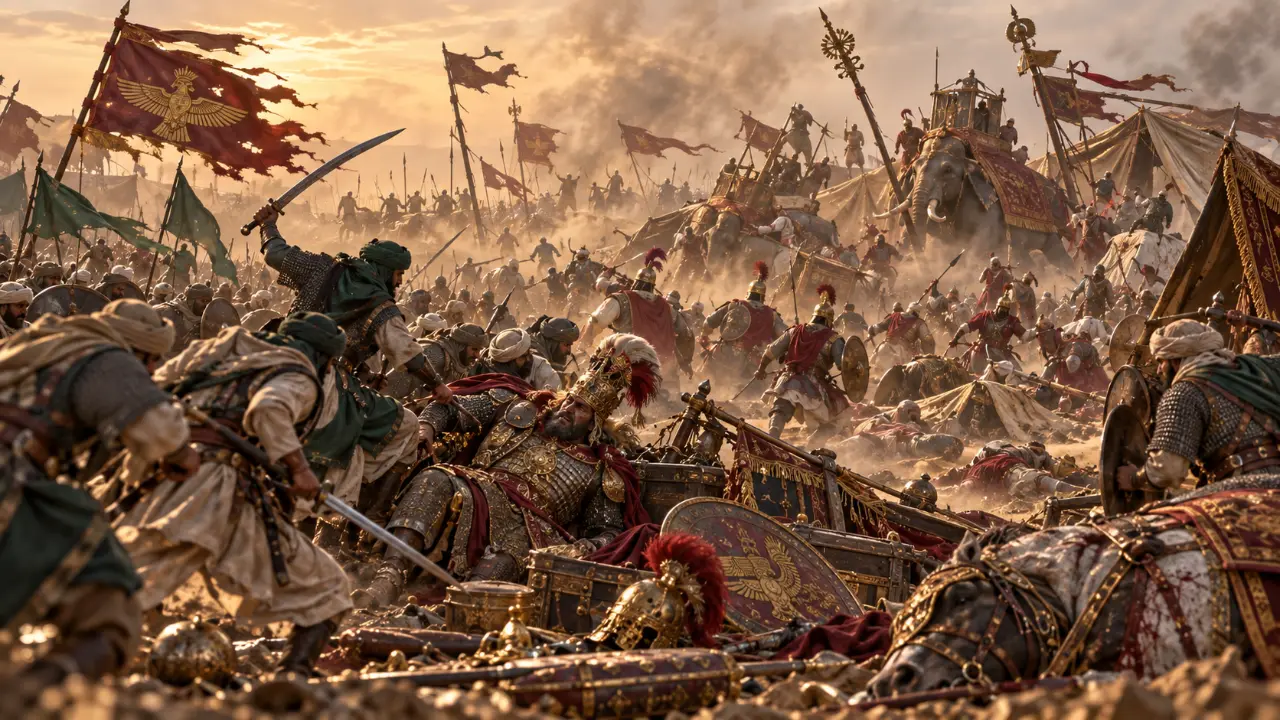
As the fourth day dawned...
Both sides had been severely depleted.
But the Persian army was beginning to lose its cohesion even more.
The elephants were no longer the decisive factor they had relied on...
And the relentless pressure from the Muslims did not cease.
Then came the decisive moment.
Accounts recall that the wind picked up...
and the Persian camp was thrown into disarray...
Then the fighting reached Rustam’s very position.
Amid the chaos and fighting...
Rustam was killed.
The death of a commander in this type of battle…
means not only the loss of a man…
but the collapse of the entire command structure.
As soon as news of his death spread…
the turmoil began to turn into a collapse.
The Persian forces retreated...
and in some places, the retreat turned into a rout.
As for the Muslims...
they rushed forward to pursue the enemy.
And thus...
the Battle of al-Qadisiyah was decided.
It was not merely a battle in which one army defeated another...
but rather a massive blow to Persia’s military prestige.
What Comes After Al-Qadisiyah?
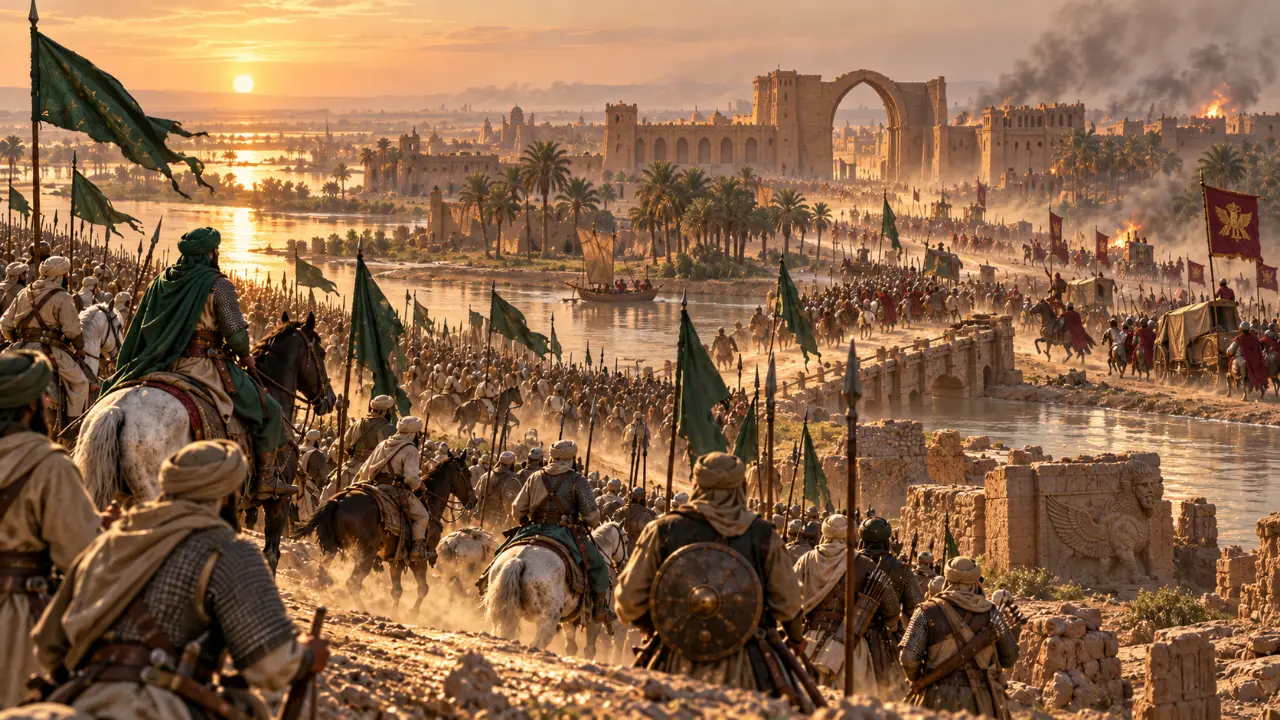
After the Battle of al-Qadisiyah...
The way was opened for the Muslims toward al-Mada’in, the capital of the Persians in Iraq.
This alone is enough to understand the magnitude of the victory.
For the battle did not merely grant the Muslims a victory on the battlefield...
but it also opened the door to political and military advances deep into the Sassanid Empire.
Al-Madain fell shortly thereafter...
And the battles continued...
Until other battles followed, such as Jalula and then Nahavand.
And from this point on...
the Sassanid Empire began to enter a phase of true collapse.
For this reason, many historians view Al-Qadisiyyah as one of the battles that changed the face of the region.
Afterward, the Persians were no longer able to regain the initiative as they had before.
And Iraq became part of the new course shaped by the Islamic conquests.