The Conquest of al-Mada’in (Ctesiphon)
The Conquest of al-Mada’in… When the Muslims Reached the Capital of Khosrow
The Conquest of Madain
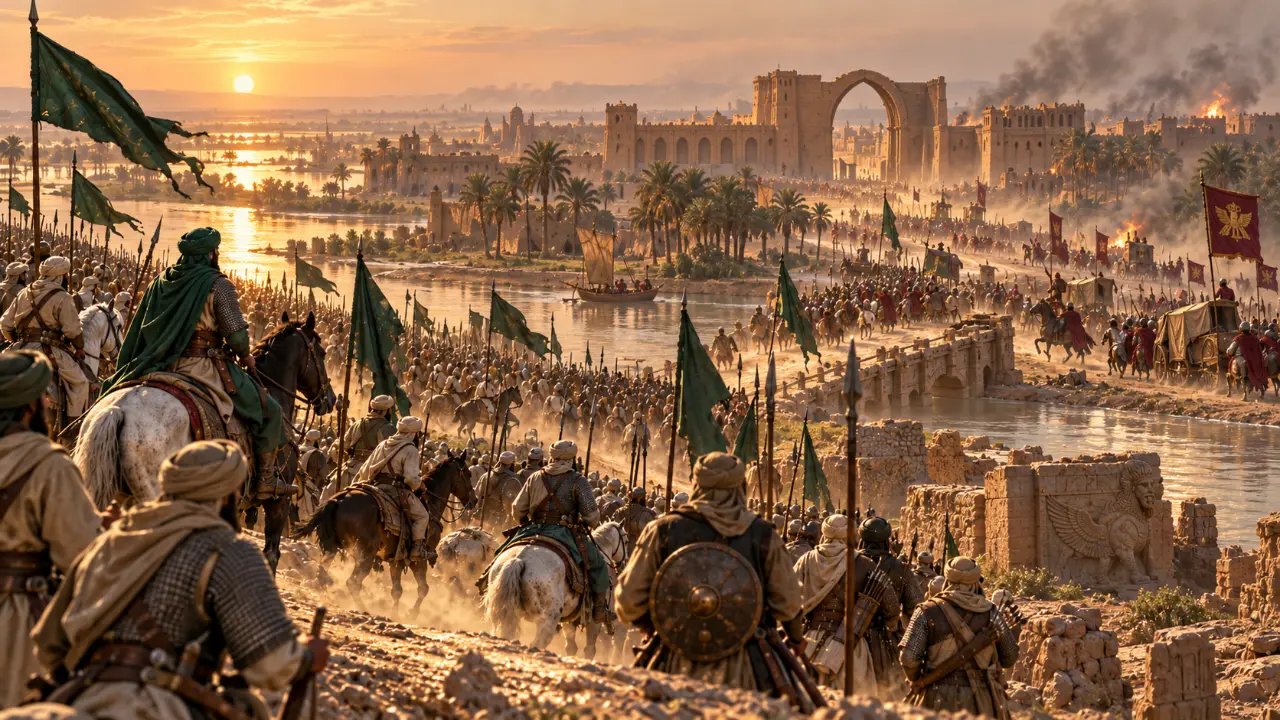
At al-Qadisiyyah, the Muslim army, led by Sa‘d ibn Abi Waqqas, clashed with the Sassanid army, which was commanded by Rostam Farrokhzad. After fierce fighting, the battle ended with a Muslim victory and the death of Rostam, whereupon the Sassanid forces retreated toward their capital.
.
.
.
And from there, the march toward al-Mada’in began.
The Road to the Capital of Persia
After the Battle of al-Qadisiyyah, Sa’d ibn Abi Waqqas had no greater goal than al-Madain itself.
News of the defeat was reaching the Sassanid capital, and with each report, anxiety grew within the palaces.
The city that had once been a symbol of Persian power now awaited an army advancing toward it from the west.
The Muslims were marching through unfamiliar territory.
Rivers, canals, farms, scattered villages, and fortresses built by the Persians to protect the roads leading to the capital.
Behind those fortifications lay al-Mada’in.
But the name al-Mada’in does not refer to just one city.
The region was, in fact, a cluster of several cities and urban centers on both banks of the Tigris River, with Ctesiphon—the royal capital of the Sassanid Empire—being its most important part.
At its heart stood that massive structure, the remains of which still stand today:
Tak Kasra or Iwan Kasra.
The First Gates of Al-Madain
The Muslims advanced until they reached the western regions of Al-Madain.
Here, the Persians were not prepared to give up the road easily.
They set up defenses and attempted to slow the advance of Sa’d’s army.
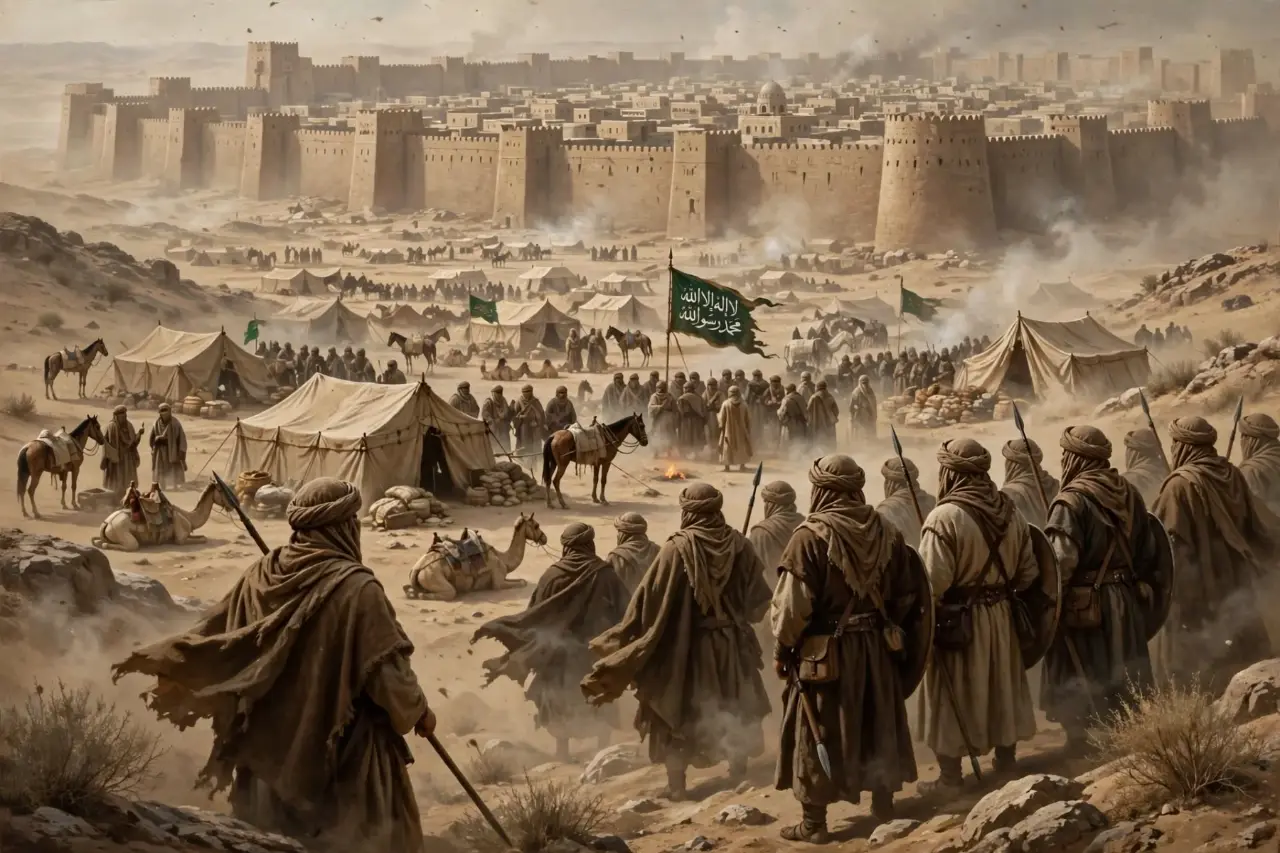
The Muslims besieged the western section of Al-Mada’in, and the siege lasted for two months
In the still darkness of the night of the month of Safar in the 16th year of the Hijra,
the towering walls of “Bahrasir” stood like a wounded giant on the west bank of the Tigris River.
This impregnable city, once the jewel of Western Al-Madain and its impregnable gateway, had been transformed into a vast prison housing the remnants of the Sassanid Empire’s pride,
after the Muslims had encircled it with an iron ring under the command of the seasoned general Sa’d ibn Abi Waqqas (may Allah be pleased with him)
. For two full months, the sun of stability was absent from the city. The narrow passageways within the walls echoed only with the whistling of the twenty catapults set up by the Muslims,
as they rained down like stones of fate upon the fortresses and wooden siege engines crawling toward the walls to tear into their structure.
The clamor of the Persian markets turned to whispers of fear, and the supply lines were completely cut off, so the specter of starvation loomed over the fighters and the residents,
until the ordeal reached its peak and the besieged were forced to eat fishhooks and dogs in a desperate attempt to stave off starvation.
In a moment of despair, a messenger emerged from within the walls bearing an offer from Khosrow Yazdgerd,
an offer dripping with defeat: “Leave us what lies beyond the Tigris and take what lies within it.” It was a flimsy bargain, offering peace in exchange for the division of the land,
but the response from the Muslim camp was firm and unyielding, presenting three options, none of which involved compromising on the geography of fear:
Either Islam,
or the jizya,
or the sword.
When the Persians realized that the walls were inevitably about to fall, and that the blows of the catapults had weakened both the stones and the hearts,
they made their final decision under the cover of darkness. Soldiers and civilians slipped away in a silent funeral procession toward the Tigris River,
and crossed to the eastern bank, where the “White Palace” and Khosrow’s iwan loomed on the horizon.
Before the sun rose, they set fire to the bridges and towed away every ship, believing that the depths of the water would protect them from the fate that awaited them.
With the first light of dawn, the Muslims advanced toward the gates only to find them wide open amid utter silence.
They entered “Behrasir” as conquerors, only to find not a single fighter there, but an empty city whose thrones they had seized along with whatever remaining equipment they could find. The Muslims stood on the riverbank, gazing at the roaring waters that separated them from the capital of Khosrow,
knowing that one chapter of the siege had ended, and that the epic Great Crossing was about to begin.
The Battalion of Horrors
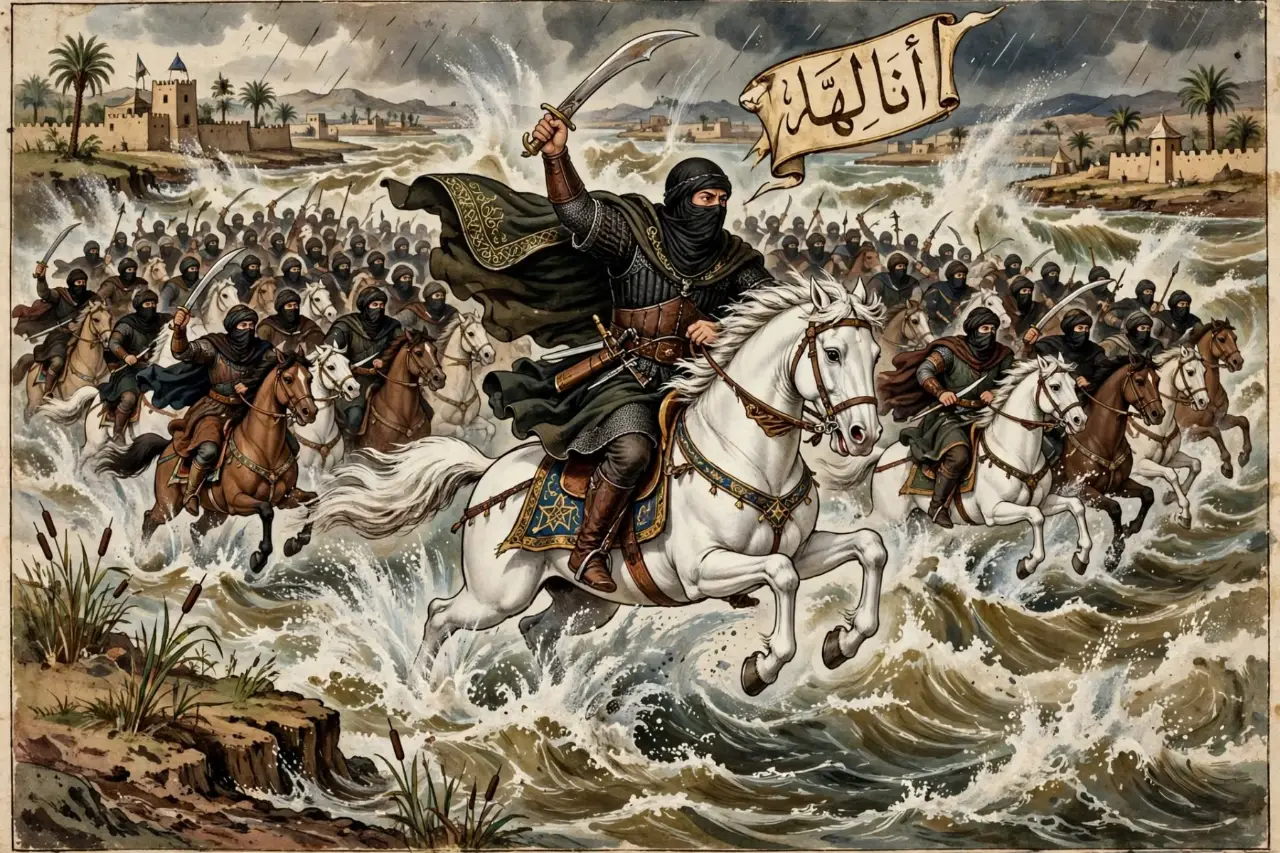
Commander Sa’d ibn Abi Waqqas stood on the western bank of the Tigris River, gazing at the crashing waves churned up by the spring flood.
The river flowed roaring, black in color and deep-bottomed, spewing foam on both sides as if issuing a challenge. On the opposite bank,
the terraces of the “White Palace” and the Iwan of Khosrow loomed on the horizon with wounded pride, surrounded by Persian soldiers who believed the river had become an eternal moat protecting them from the Muslim advance,
after they had burned the bridges and towed away all the ships. The situation called for a miracle, for waiting meant giving the Persians a chance to reorganize their ranks.
Sa’d gathered his men, delivered a speech to rouse their spirits, and then said with the confidence of one certain of God’s victory: “I have resolved to cross this sea to reach them,”
and the army immediately pledged allegiance to him, vowing to die and cross
. The hero Asim ibn Amr al-Tamimi led the way at the head of sixty fighters from the “Battalion of Terror,”
riding their horses toward the water’s edge. They did not hesitate; rather, they charged into the raging river,
followed by their horses, which began to swim through the water as if running on a dirt track. At that moment,
Commander Asim turned to his soldiers amid the spray of the waves and shouted: “Spears! Spears! Throw the spears!”
The Persians on the eastern bank were struck with astonishment and panic as they watched the Arab horsemen traverse the river they had believed impossible to cross.
The Persians drove their cavalry into the water to try to repel the Muslims and keep them from reaching the shore,
and the two forces clashed in the heart of the waves in a unique epic battle;
horses swimming, swords flashing, and spears piercing the necks of the horses in the middle of the river
. The Muslims fought valiantly and stabbed the Persian horses in the faces, causing them to flee,
and the “Battalion of Terror” managed to take control of al-Fardah (“Sword of the Sea”) on the opposite bank and secure it.
The Flight of Yazdegerd
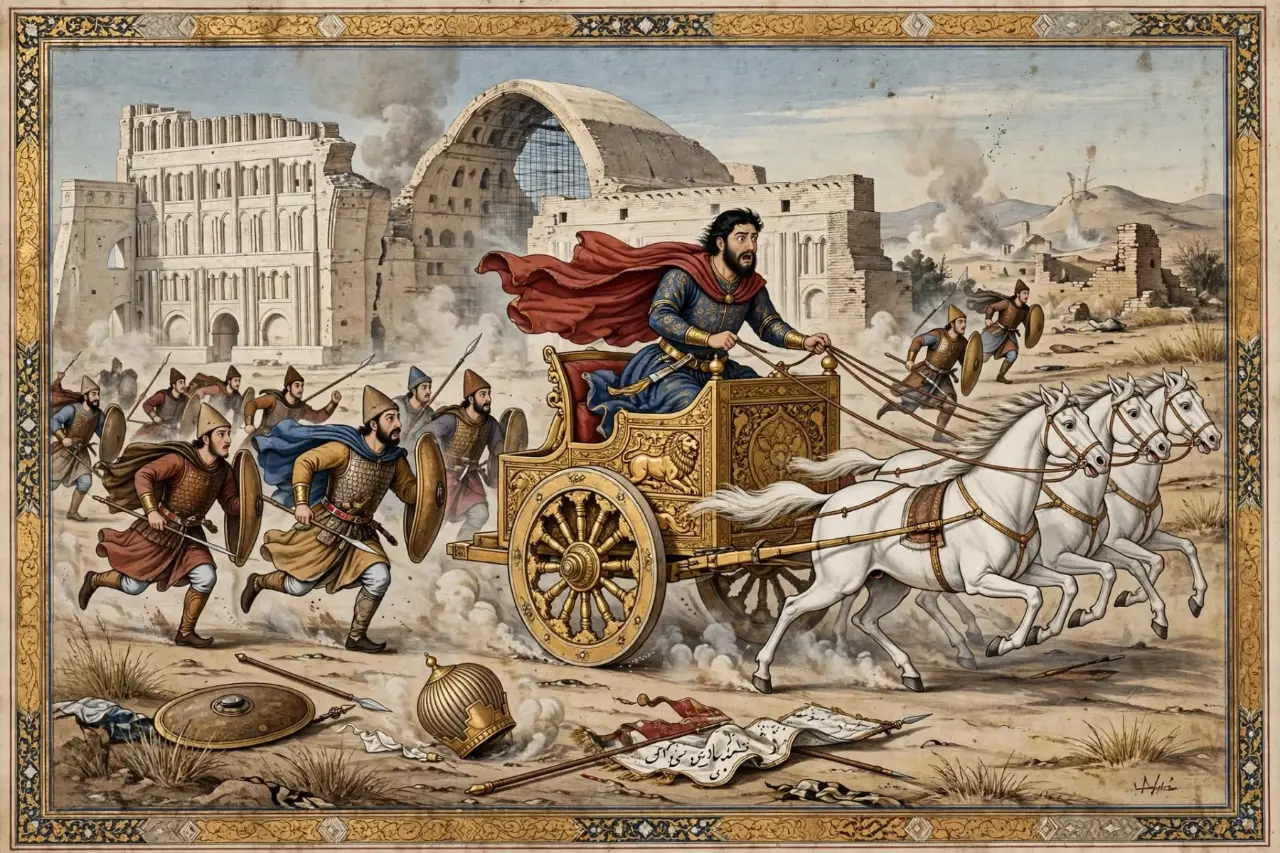
As the takbir shook the very foundations of the “White Palace,” the Sassanid king Yazdegerd III was experiencing one of his most terrifying and devastating nights.
He was only twenty-something years old, but he found himself carrying on his slender shoulders the legacy of an empire crumbling like scraps of paper in the face of the storm of the Islamic conquest
. In a closed back room, surrounded by servants and bodyguards gripped by panic, Yazdegerd personally oversaw the gathering of whatever could be salvaged from his ancestors’ legacy
. Suitcases were hastily stuffed with gold and pearls, sacred Persian manuscripts, and delicate royal jewelry.
There was no chance to look back; news coming from the river confirmed that “the men riding the swimming horses” had already set foot on the eastern bank,
and that the distance between them and the palace walls was shrinking with every passing minute.Yazdegerd cast one last glance at the iwan of his grandfather, Khosrow Anushirvan, his eyes brimming with tears of despair, then mounted his horse amid a silent funeral procession of his family, his entourage, and a thousand of his valiant guards. They exited through the rear gates of Ctesiphon under cover of darkness, dragging the tails of disappointment behind them, fleeing eastward toward “Helwan” in the Zagros Mountains.The escape was humiliating for a king whom his people regarded as a god or the son of the most exalted kings. The procession took rough side roads for fear of being pursued by Muslim horsemen, and every echo of the wind or the sound of horses’ hooves in the night struck terror into the hearts of the entourage, who feared that Sa’d’s troops had caught up with them. All along the way, Yazdegerd was bitterly swallowing the pain of betrayal and abandonment by some of his marzban (provincial governors), who began to desert him one by one after realizing that the sun of the Sassanid dynasty had set never to rise again.Yazdegerd left behind his great capital, his suspended crown, and his legendary carpet, transforming from a king who ruled half the ancient world into a fugitive seeking refuge in the far reaches of Persia, chasing a mirage in the mountains of the East, while Al-Madain was being rebuilt by the pure-hearted conquerors.
The Army’s Crossing
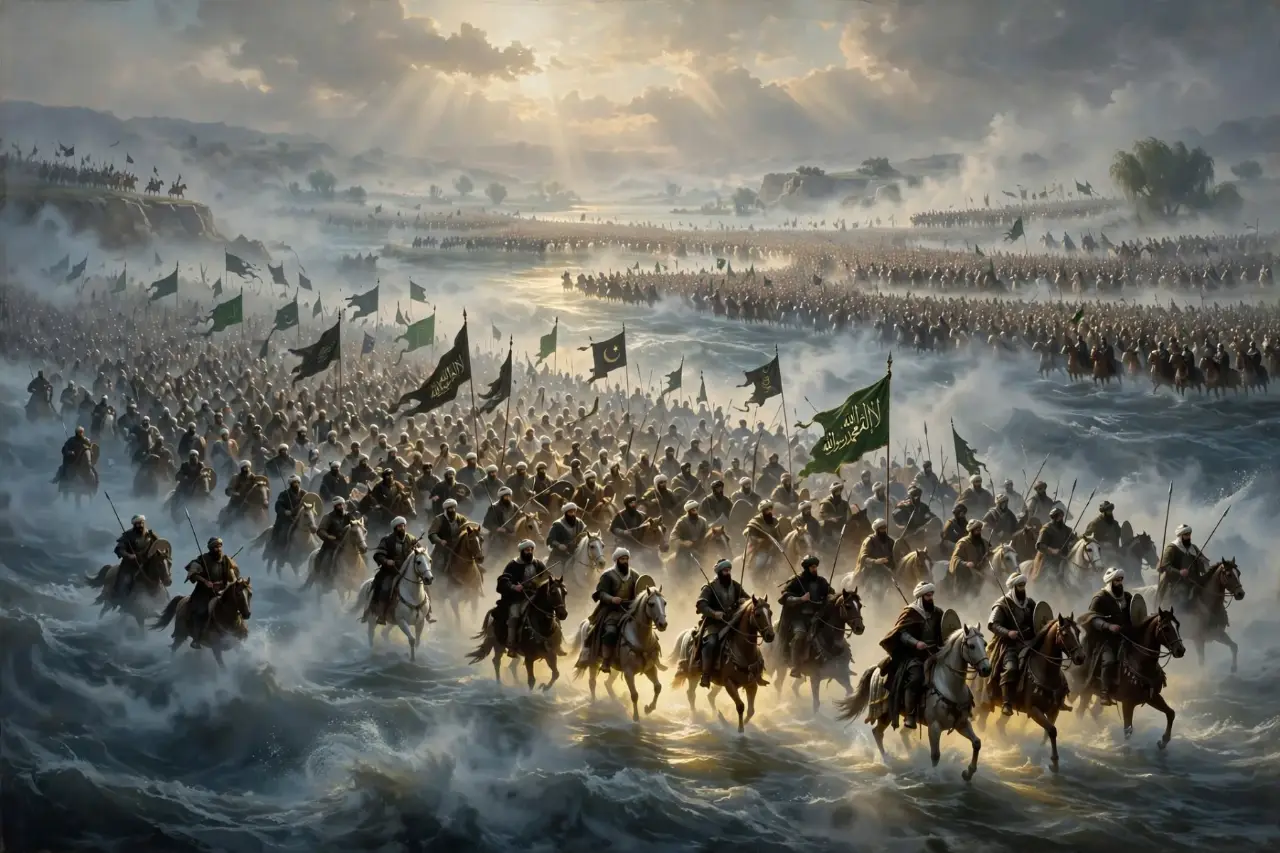
At that moment, Sa‘d ibn Abi Waqqas gave the order for the rest of the army to cross,
and thousands of horsemen rode across all at once, until the river was choked with men and horses.
The Muslims spoke and recited poetry amid the waves, their hearts filled with serenity,
as if they were walking on dry land, in a legendary scene recounted in historical narratives. And within mere hours,
the horsemen’s feet had reached the eastern bank, and the echoes of the takbir rose to shake the very foundations of the capital of Khosrow.
The remnants of the Persian army fled toward Eastern Al-Mada’in, leaving behind the empire’s last stronghold,
so that the Muslims might, with their own hands, turn a new page that erased the formidable boundaries between East and West
The Iwan of Khosrow
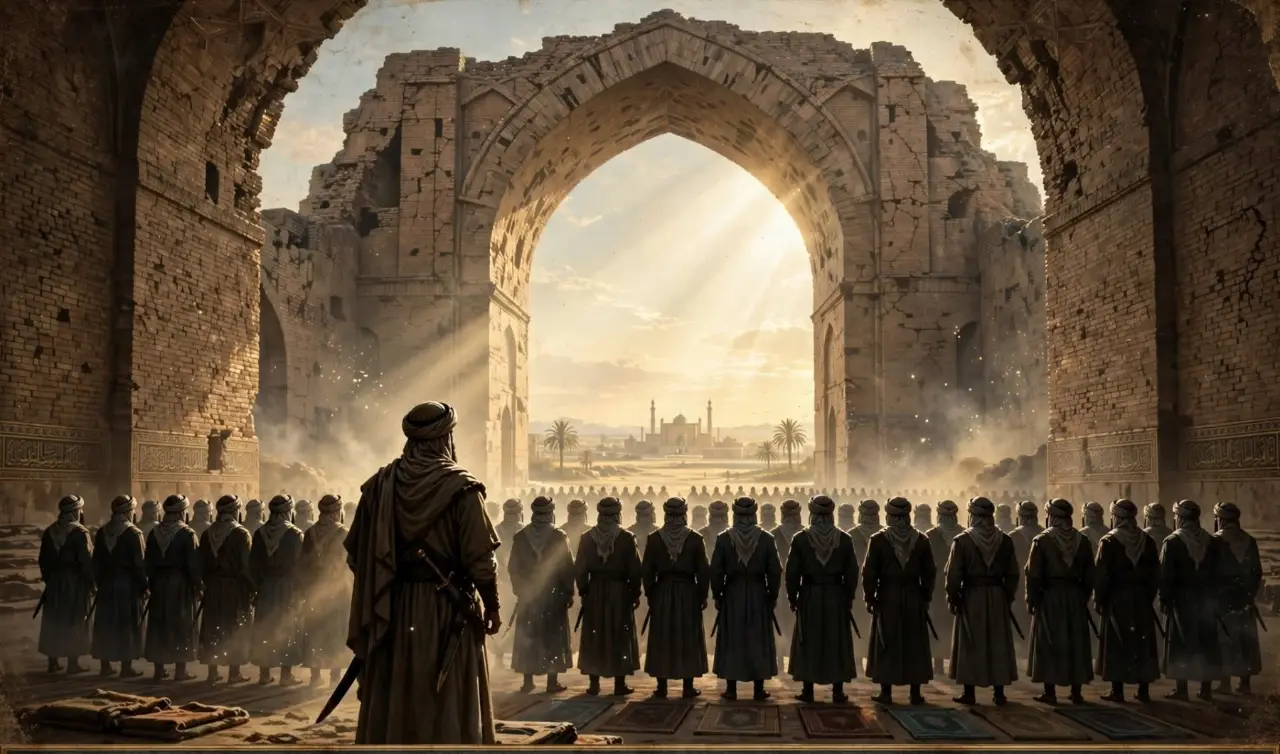
Commander Sa’d ibn Abi Waqqas rode his horse through the streets of Eastern Madain, shrouded in an atmosphere of grandeur and decline,
until he came to a halt before the gates of the “White Palace” and the towering iwan of Khosrow. Silence enveloped the place that had long been teeming with conspiracies and kings,
and the spacious halls seemed empty, as if their inhabitants had left only yesterday, leaving behind silk robes, luxurious furnishings, and golden thrones that had failed to protect an empire that had lasted for centuries.
Saad dismounted from his horse, his eyes brimming with tears, and crossed the long hall leading to the heart of the great iwan.
He did not enter as a victorious king seeking to assert his supremacy, but rather humbly, with his head bowed in thanks to God, reciting in a trembling voice whose echo reverberated beneath the high arched ceiling
:﴿How many gardens and springs have they left behind! And crops and a noble station! And blessings in which they used to revel! Thus, We have bequeathedto another people﴾
. The scene presented a striking contrast: warriors in their simple garments, stained by the blood of battle and the dust of travel,
standing in awe before the gilded throne of Khosrow and the king’s crown, studded with rubies and emeralds and suspended from the ceiling by gold chains due to its weight.
But the astonishment did not last long; in a matter of moments, the hall transformed from a symbol of Khosrow’s tyranny into a prayer hall for the monotheists
. Sa’d designated a prayer hall in the heart of the palace, and the first Friday prayer was held in the Persian capital in the month of Safar. The call to prayer rang out across the skies of al-Mada’in for the first time in history,
mingling with the takbir that shook the Iwan of Khosrow so violently that its ancient walls nearly spoke.And in the corners of the palace,
the rarest spoils of the earth began to gather: the legendary carpet (Qatf Khosrow), made of silk and gold and embellished with jewels; the swords of kings; and the jewelry that told the story of the empire’s wealth.
And here the integrity of these knights, who had gone hungry for months, shone through: a warrior would bring a precious gem worth thousands and hand it over to the officer in charge of the spoils without a single stone missing,
and Sa’d uttered his immortal words as he gazed at the glittering piles: “This is an army that has served a trustworthy leader.”
That moment marked the end of the Sassanid era in Iraq and the birth of a new era from the heart of the open capital of Khosrow.