The Great Battle of Badr
The First Decisive Battle in Islam
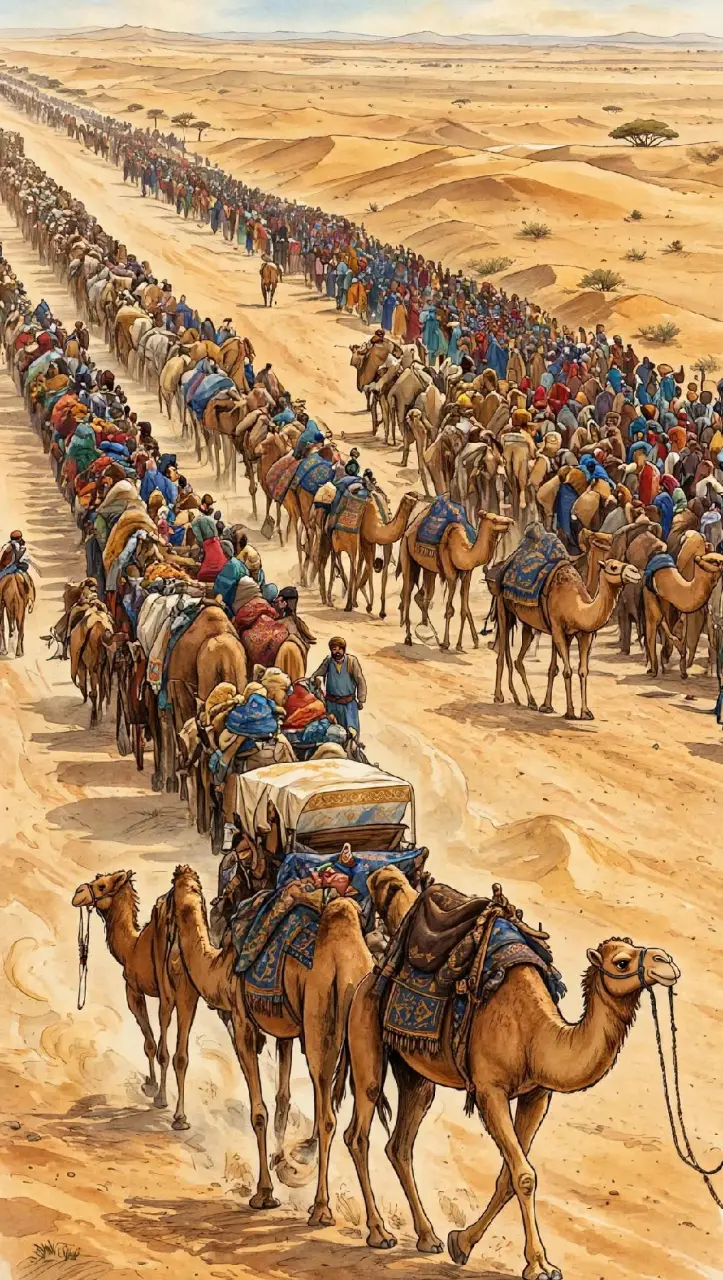
• A large Quraysh trade caravan led by Abu Sufyan ibn Harb set out from Syria, returning to Mecca.
• The Muslims wanted to intercept the caravan to recoup the wealth they had left behind in Mecca and to counter the oppression of the Quraysh, so the Prophet ﷺ called on his companions to set out.
• Abu Sufyan escaped with the caravan and changed his route, but Abu Jahl insisted that the Quraysh army advance to fight the Muslims and demonstrate their strength.
Quraysh Rallies to the Caravan
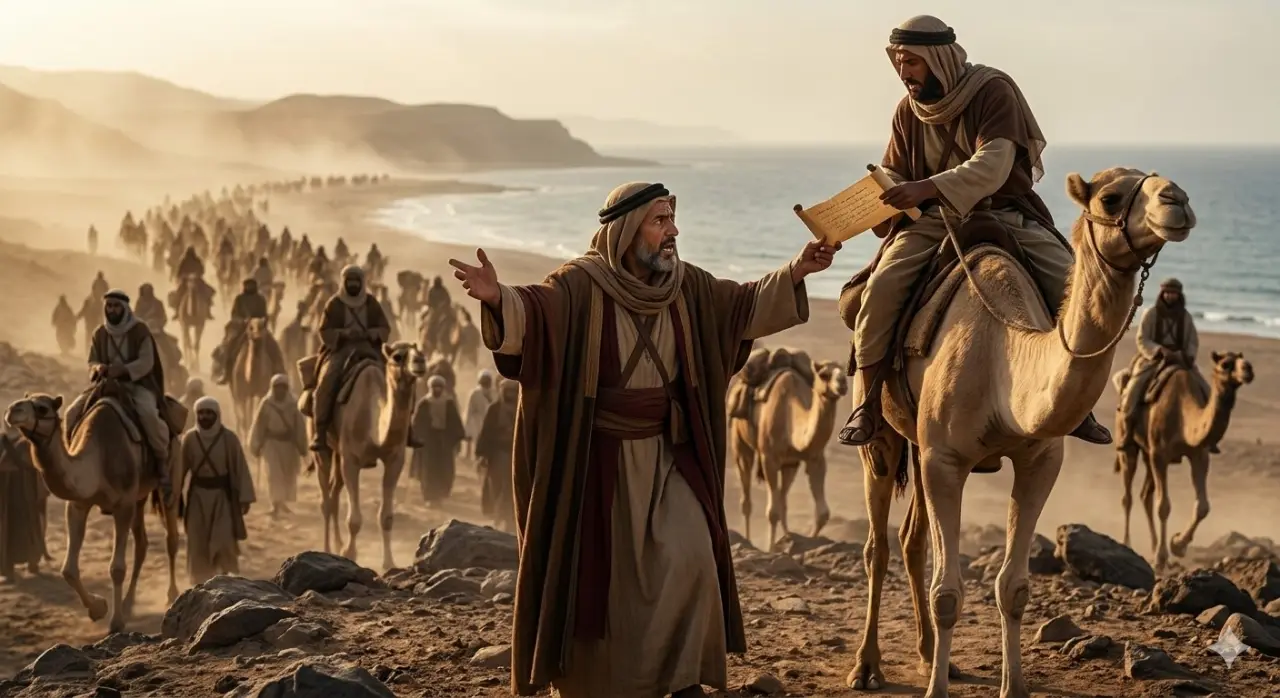
The sun was setting over the barren desert when Abu Sufyan ibn Harb stood atop a sand dune, scanning the horizon. Below him was a great caravan of the Quraysh, consisting of a thousand camels laden with the wealth and riches of Mecca returning from Syria. He breathed in the air cautiously, for news had reached him: the Prophet Muhammad ﷺ and his companions had set out from Medina to intercept the caravan.
The Muslims’ desire to intercept the caravan was not for the purpose of plunder, but rather to reclaim some of their rights that the Quraysh had confiscated in Mecca after forcing them to emigrate without their money or trade goods.
With intelligence and shrewdness, Abu Sufyan diverted the caravan’s route toward the Red Sea coast and sent a urgent cry for help to Mecca: “O sons of Abd al-Manaf! Woe to us! Your wealth, which is with Abu Sufyan, is now threatened by Muhammad and his companions. Help! Help!”
The Spark of War and the Stubbornness of Pride
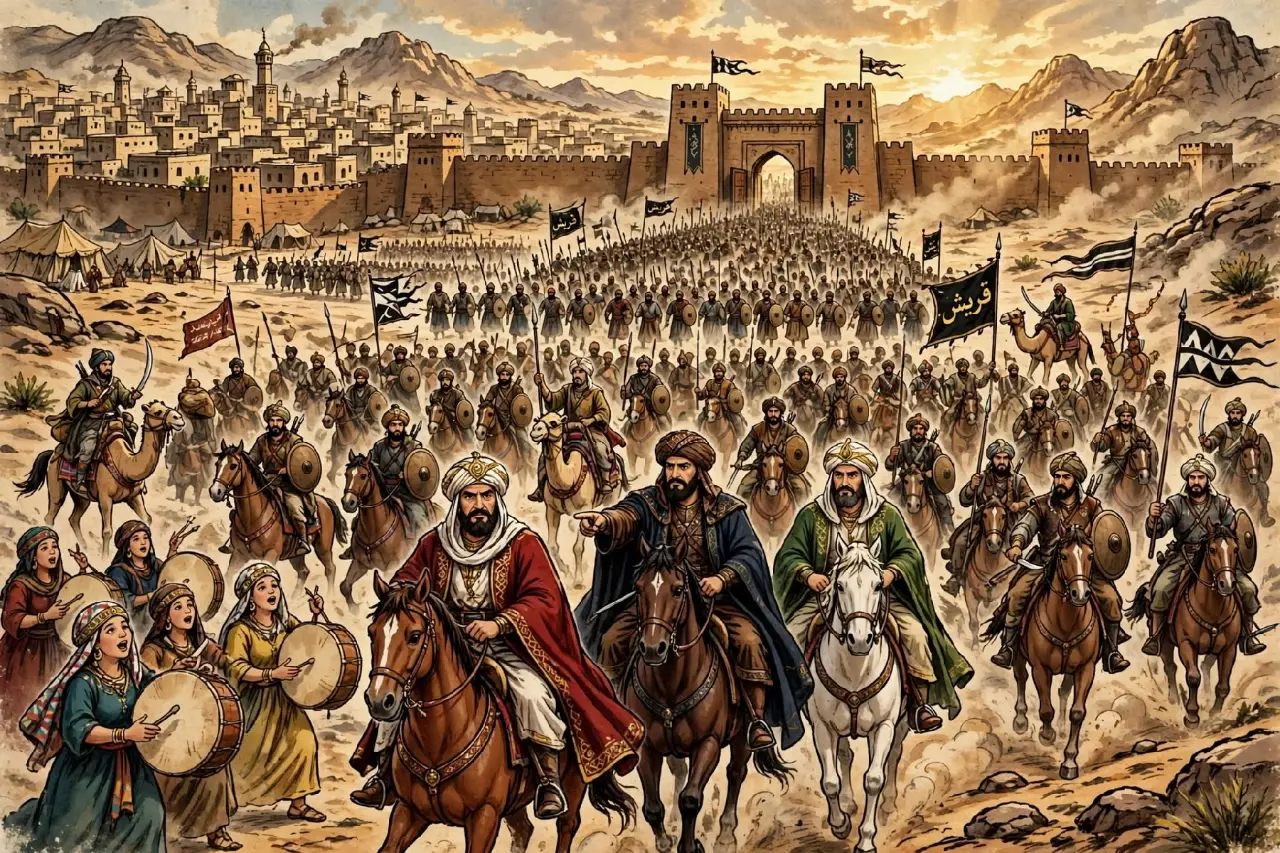
Mecca was ablaze with zeal and anger. Within days, a massive army of nearly 1,000 fighters had gathered, led by the nobles and horsemen of Quraysh, accompanied by singers and drummers who sang and boasted of their strength.
Meanwhile, Abu Sufyan had managed to lead the caravan to safety, and he sent word to the Meccan army asking them to return, as the danger had passed. At that moment, Abu Jahl (Amr ibn Hisham) stepped forward with his usual arrogance and shouted at them: “By God, we will not return until we reach Badr, where we will stay for three days; we will slaughter the sheep, serve food, and make the Arabs hear of us, so that they will fear us forever!”
Shura and the Construction of the Arish
News reached the Prophet ﷺ as he was setting out. It was no longer just a simple trade caravan, but a direct confrontation with the entire army of Mecca. The Prophet ﷺ turned to his companions to consult them, for the Ansar had pledged allegiance to protect him within the city, and now they were outside it.
Al-Miqdad ibn Amr, one of the Muhajirun, stood up and spoke words that have gone down in history: “O Messenger of Allah, proceed as Allah has guided you, for we are with you. By Allah, we will not say to you what the Children of Israel said to Moses: ‘Go, you and your Lord, and fight; we will stay here,’ but rather, ‘Go, you and your Lord, and fight; we will fight alongside you.’”
Then the Prophet ﷺ turned, wishing to hear from the Ansar. Sa’d ibn Mu’adh understood the gesture, so he stood up and said with firmness and certainty: “Perhaps you fear, O Messenger of Allah, that the Ansar might truly believe it is their duty to support you only within their own homes… By the One who sent you with the truth, if you were to lead us across this sea, we would wade through it with you, and not a single man among us would stay behind… Untie the ropes of whoever you wish, cut the ropes of whoever you wish, and take whatever you wish from our wealth!”
The Prophet’s ﷺ face lit up with joy, and he said: “Go forth and give good tidings, for Allah has promised me one of the two groups, and by Allah, it is as if I am now looking upon the battlefield where the people are fighting.”
The Night of the Battle: Rain and Tranquility
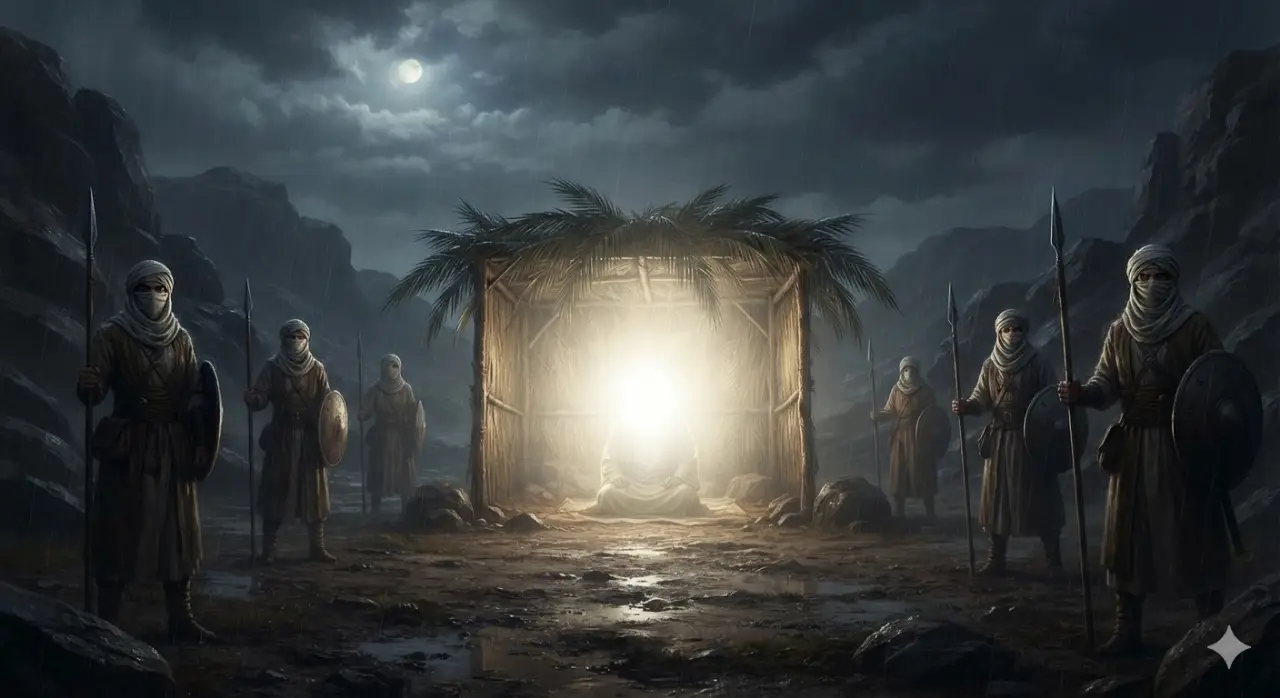
The Muslims—numbering only about 313 men, accompanied by horsemen and seventy camels that they took turns riding—set out toward the wells of Badr. The Companion Al-Habab ibn al-Mundhir, with military ingenuity, suggested that the Muslims camp at the lowest of the Quraysh’s wells and then fill in (bury) the wells beyond it, so that the Muslims could drink while the polytheists could not. The Prophet ﷺ agreed immediately.
The Companions built a command post for the Prophet ﷺ on a hill overlooking the battlefield, and Abu Bakr al-Siddiq stood with his sword drawn, guarding the post.
That night, Allah sent a light rain upon the Muslims. A gentle drizzle fell on the Muslims, stabilizing the sand beneath their feet and instilling tranquility in their hearts, while a heavy downpour fell on the Quraysh, turning the ground into mud that hindered their movement. The Muslims slept through the night in safety and security, gathering their strength for the decisive day.
The Morning of the Battle: Supplication and Combat
On the morning of the seventeenth of Ramadan, the two armies lined up. The Quraysh looked on with arrogance and pride, while the Muslims looked on with certainty and steadfastness.
The Prophet ﷺ entered his tent and raised his hands to the heavens, supplicating to his Lord while weeping, his beard wet with tears, until his cloak slipped from his shoulders, as he said: “O Allah, if this group of Muslims is destroyed, no one will worship You on earth after this day.” Then Abu Bakr al-Siddiq came to him with compassion, lifted his cloak, and said, “O Messenger of Allah, enough of your supplication to your Lord, for He will fulfill what He has promised you.”
The Prophet ﷺ went out to the people, urging them to fight, and said: “By the One in Whose hand is the soul of Muhammad, no man fights them today—killed while patient and seeking reward, advancing without retreating—except that Allah will admit him to Paradise.” ‘Umayr ibn al-Hamam, eating dates as he spoke, said, “Bah! Bah! Is there anything standing between me and Paradise except that these men kill me?” Then he threw away the dates and fought until he was martyred.
The battle began with one-on-one duels, which served to break the enemy’s morale. Three of the Quraish’s fiercest horsemen stepped forward: ‘Utbah ibn Rabi’ah, Shaybah ibn Rabi’ah, and al-Walid ibn ‘Utbah. From among the Muslims, three members of the Prophet’s household stepped forward to face them: Hamzah ibn ‘Abd al-Muttalib, ‘Ali ibn Abi Talib, and ‘Ubaydah ibn al-Harith.
In the blink of an eye, Hamza struck down Shaybah, Ali knocked Al-Walid to the ground, and Ubaydah was wounded before Hamza and Ali finished off ‘Utbah and came to the aid of their companion. It was a devastating blow to the Quraysh’s self-confidence.
The Great Convergence and the Descent of the Angels
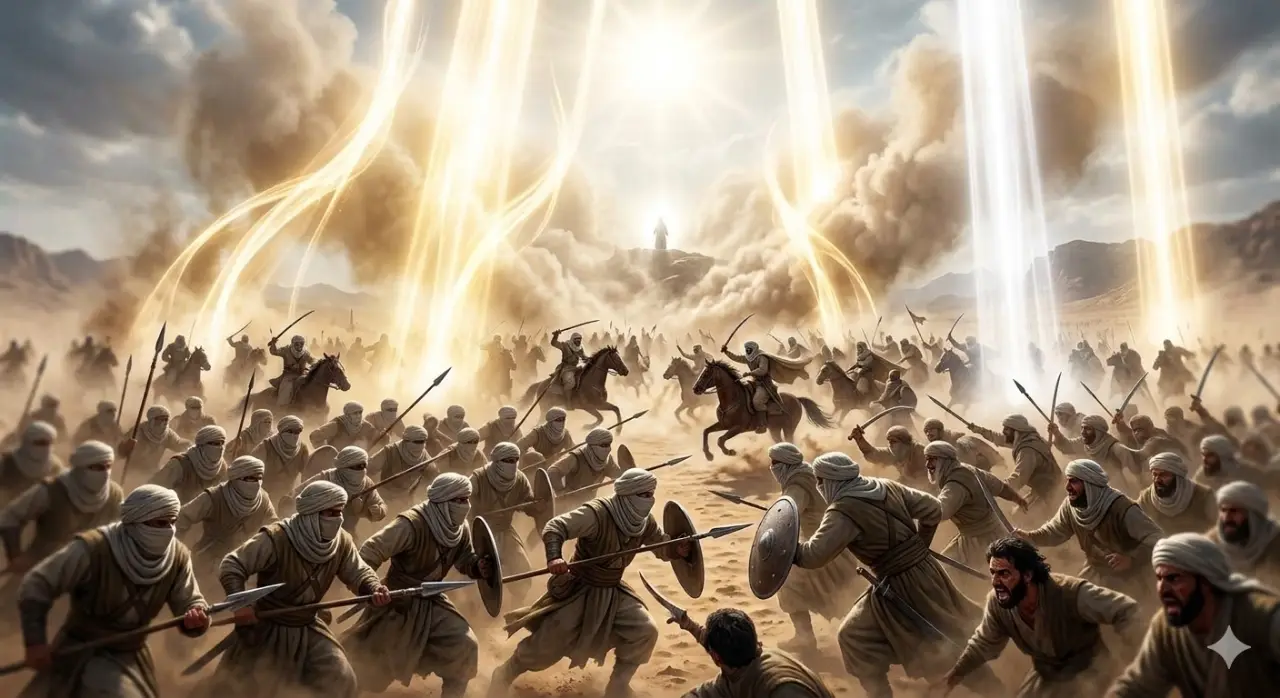
The two armies clashed, the battle raged, and dust swirled in the valley. The Prophet ﷺ took a handful of pebbles and dust and threw them at the faces of the Quraysh, saying: “Shame on you!” Not a single polytheist was left without that dust entering his eyes and nostrils, distracting them from the battle.
At the height of the battle, the angels descended, flanking the Muslims, steadying them and fighting alongside them, as Allah, the Exalted, said: (When your Lord revealed to the angels, “I am with you, so strengthen those who have believed.”)
The battle witnessed moments that shook the desert; the two young men, Mu’adh ibn ‘Amr ibn al-Jamuh and Mu’awwidh ibn ‘Afra’, ran back and forth asking about ‘Abd al-Rahman ibn ‘Awf: “O uncle, where is Abu Jahl?” When he pointed him out, they darted forward like two falcons and struck him with a blow that brought him down to the ground, where he met a most wretched death.
The Day of Al-Furqan and the Historic Victory
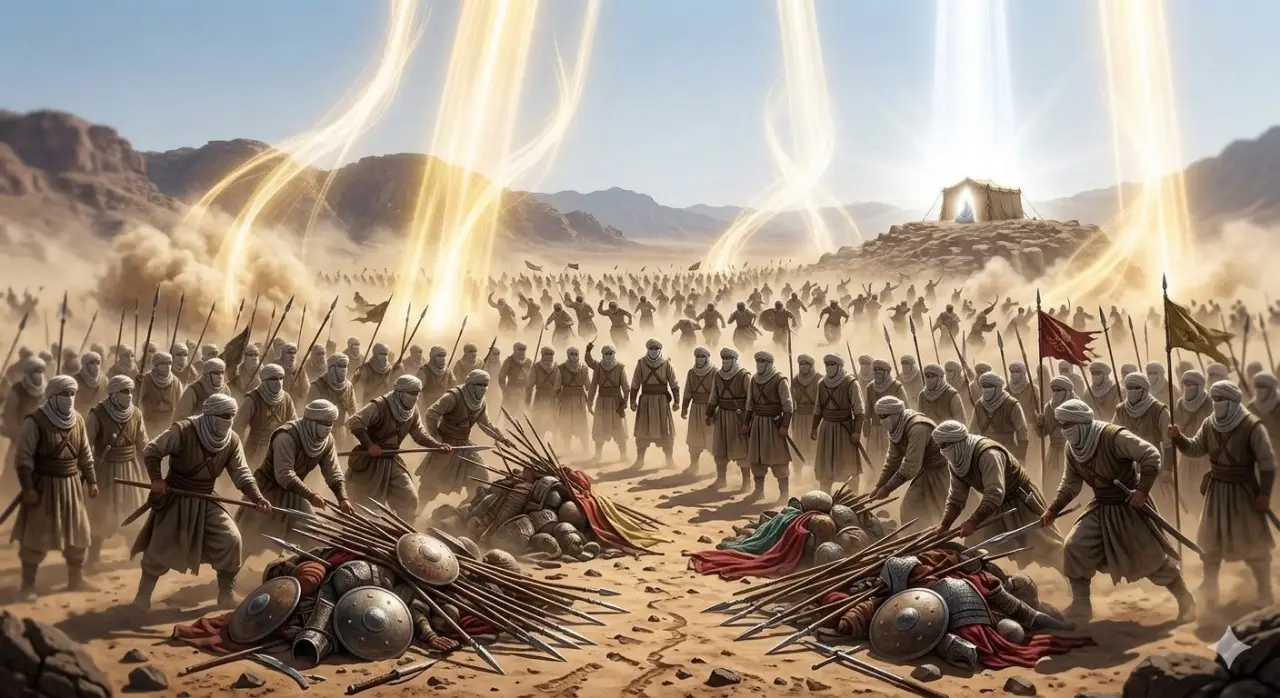
The Quraysh could not bear the shock; their army fell apart, and they fled, leaving their equipment and weapons behind.
The battle ended in a resounding and decisive victory for the Muslims, and this day was named in the Quran “The Day of Distinction” because it distinguished between truth and falsehood.
• Quraysh casualties: 70 men were killed (including prominent tyrants such as Abu Jahl and Umayya ibn Khalaf), and another 70 were taken captive.
• Muslim martyrs: Only 14 martyrs, whose souls ascended to their Creator, heralding the dawn of a new era for Islam, as the balance of power in the Arabian Peninsula shifted forever.