The Battle of Yarmouk: Days That Brought About a Turning Point
The Battle That Changed the Fate of the Levant
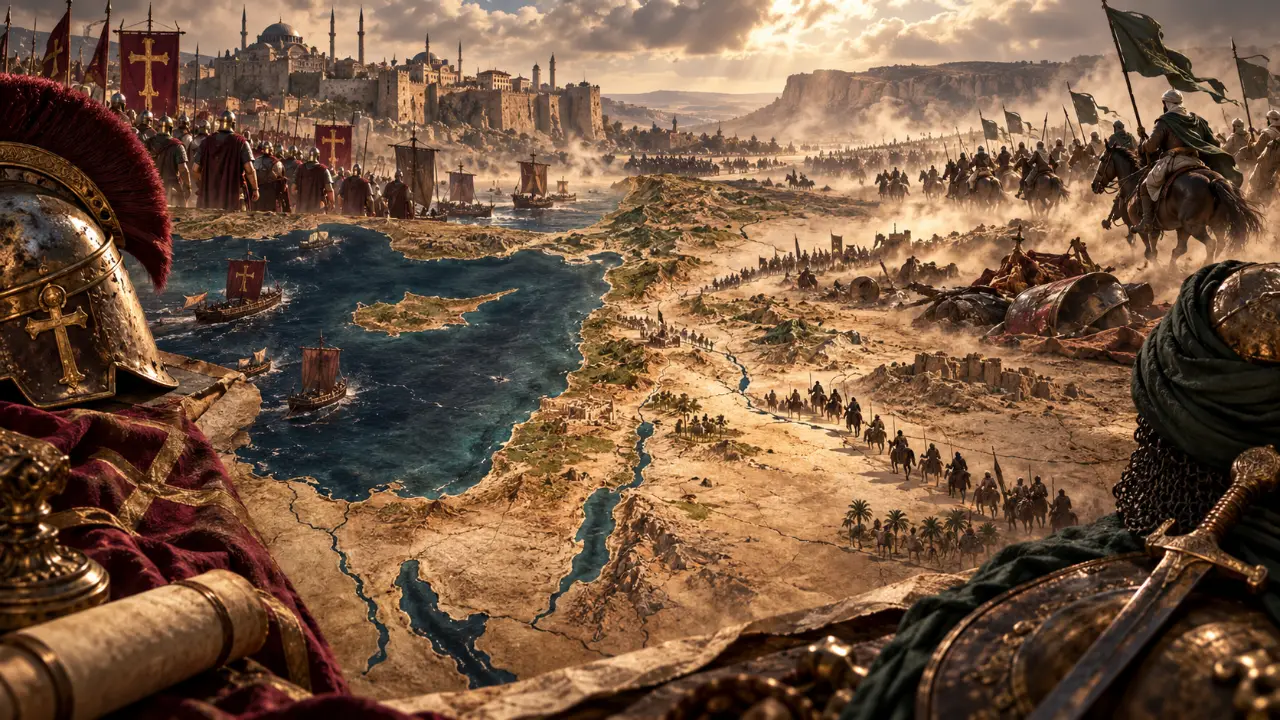
In the year 636 CE...
Specifically, on the 15th of Rajab 15 AH / August 636 CE
Two armies stood on rugged terrain near the Yarmouk River.
On one side was one of the greatest empires of the world at that time... the Byzantine Empire.
An army with centuries of combat experience, armored cavalry, and commanders who had fought the Persians in one of the longest wars the ancient East had ever seen.
And on the other side...
the army of the emerging Islamic State.
A state in which only about four years had passed since the death of its Prophet, Muhammad ﷺ.
And among the ranks of this army was a man whose name became synonymous with the most famous battles in Islamic history...
Khalid ibn al-Walid.
For several days, the Byzantine army tried to break through the Muslim lines.
First on the right...
Then on the left...
At times, the Muslims came very close to military disaster.
But on the final day, everything changed.
Khalid ibn al-Walid’s cavalry launched a massive attack...
and one of the largest armies ever sent by the Byzantines to the Levant collapsed.
Yarmouk was not just another battle.
Afterward, the Levant was never the same again.
So how did the Muslims and the Byzantines come to this confrontation?
And why did Khalid choose the Yarmouk region?
What happened during those days of fighting?
And how did an army that had been defending its positions transform into an army that launched an offensive that ended the battle?
This is...
the story of the Battle of Yarmouk
The World Before Yarmouk
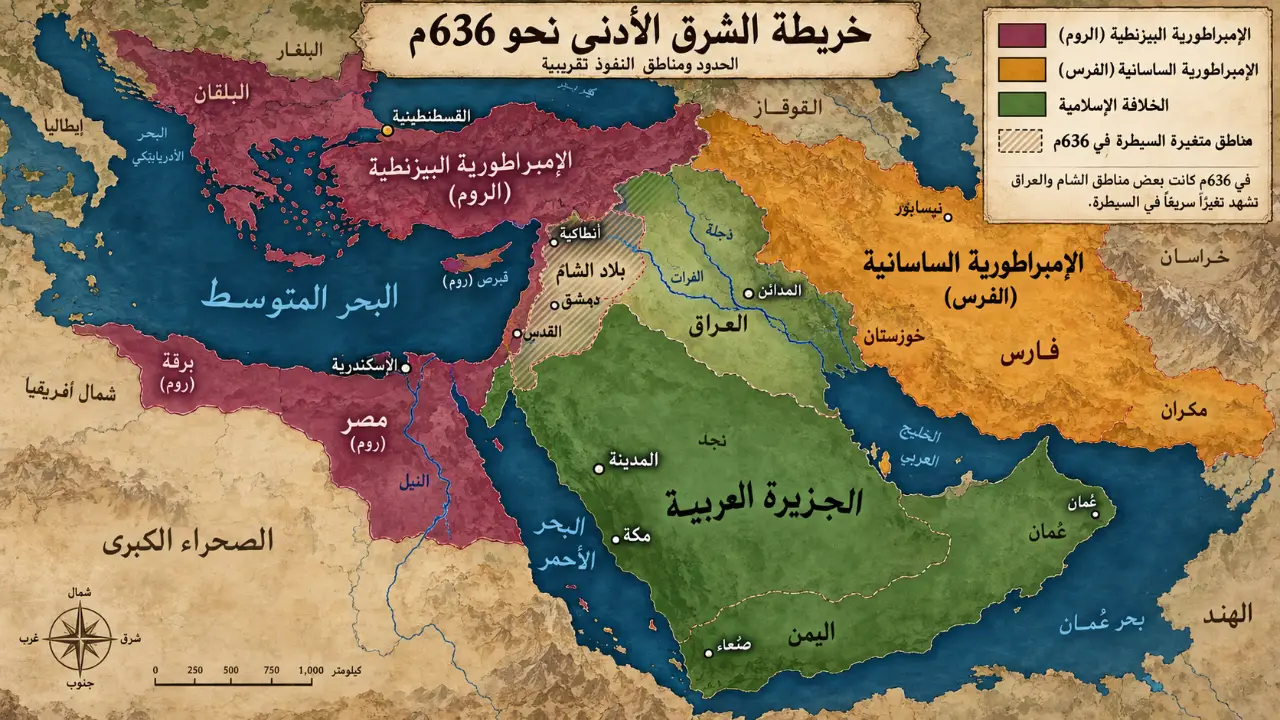
To understand the Battle of Yarmouk, we must go back several years.
At the beginning of the 7th century CE, the region was controlled by two great powers:
the Byzantine Empire in the west...
and the Persian Sassanid Empire in the east.
The two empires waged a devastating war that lasted for many years.
At first, the Persians achieved tremendous victories.
Vast swaths of the Levant fell to them.
Then Jerusalem.
Then Egypt.
At one point, it seemed that the Byzantine Empire itself was in danger of collapsing.
But the Byzantine Emperor Heraclius managed to turn the tide of the war.
He led counteroffensives deep into Persian territory and eventually forced them to retreat.
Syria, Palestine, and Egypt returned to Byzantine rule,
but the victory came at a high cost.
The long years of war had exhausted both empires economically, militarily, and in terms of human life.
And before the region could fully regain its stability...
a new power emerged from the south.
The Beginning of the Conquests in the Levant
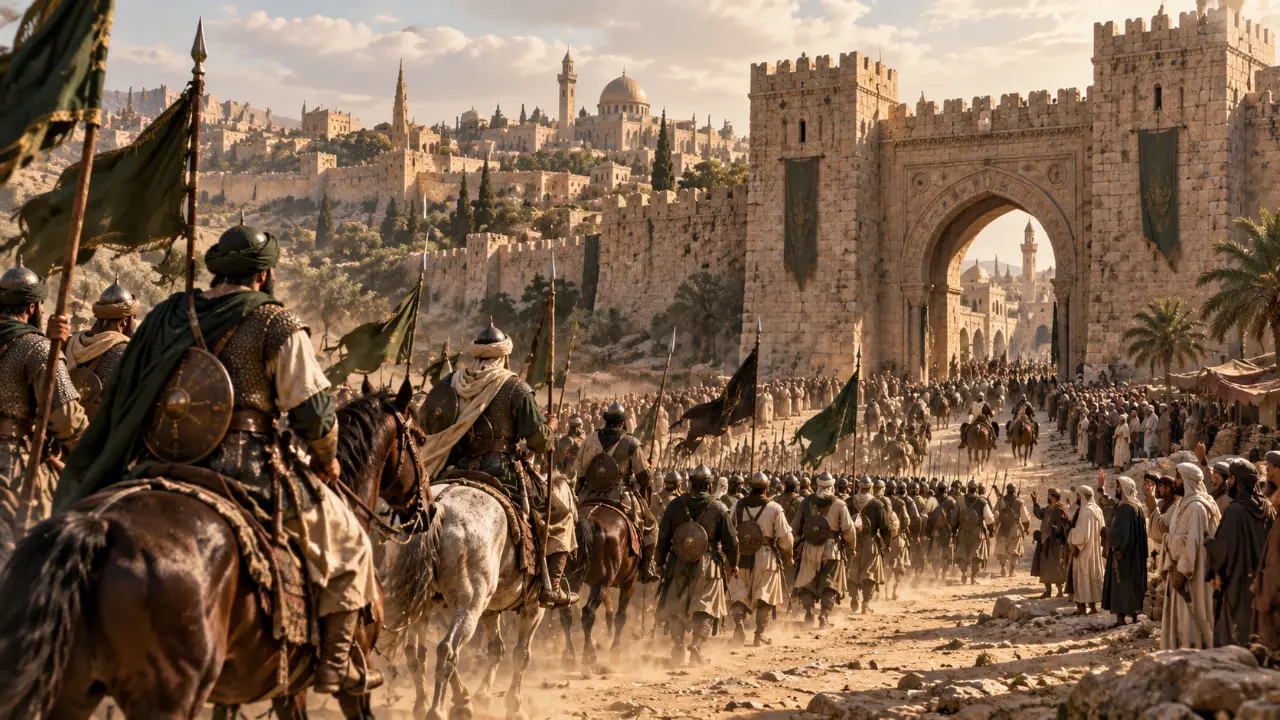
After the end of the Ridda Wars during the reign of Caliph Abu Bakr al-Siddiq, may Allah be pleased with him, Muslim armies began to move beyond the Arabian Peninsula.
Some headed toward Iraq...
while other armies moved north toward the Levant.
The Islamic forces in the Levant were divided into several armies led by a number of the Companions and commanders, including:
Abu Ubaydah ibn al-Jarrah.
Amr ibn al-As.
Yazid ibn Abi Sufyan.
Shurahbil ibn Hasana.
May Allah be pleased with them all.
At the same time, Khalid ibn al-Walid was fighting in Iraq.
However, the situation in the Levant required reinforcements.
So an order was issued for Khalid to move from Iraq to the Levant.
His arrival marked a significant turning point in the course of military operations.
Then came the Battle of Ajnadayn in 634 CE, which ended in a Muslim victory.
After that, the operations continued in rapid succession.
Then came the Battle of Fahil.
Damascus fell.
The Muslims then advanced northward.
The Islamic forces reached Homs.
As for Emperor Heraclius...
It was no longer a matter of a series of border raids that could be contained.
Rather, it had become a real threat to Byzantine control over the entire Levant.
A large-scale military response was inevitable.
Hercules' Decision
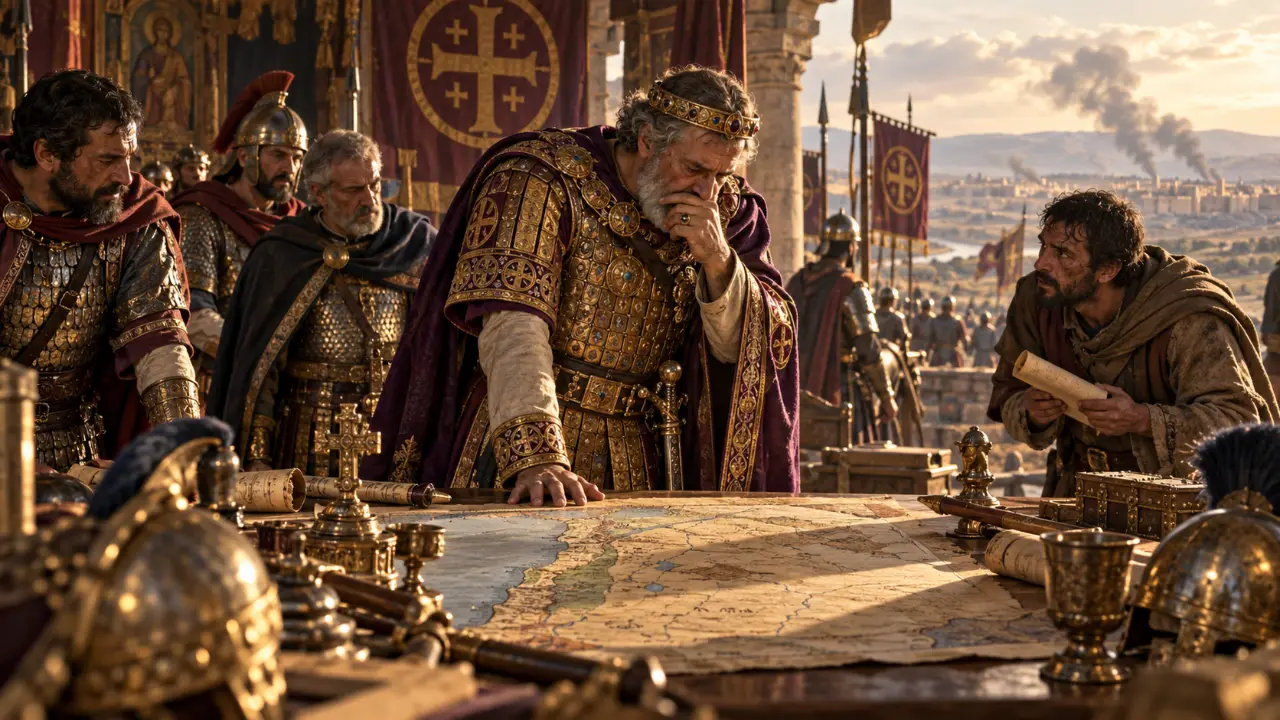
The Byzantines began to assemble a large army.
Units arrived from various regions of the empire.
Romans.
Armenians.
And local and allied forces.
Among the most prominent commanders associated with the campaign was the Armenian commander Vahan.
The objective was clear:
Not merely to halt the Muslims’ advance…
but to drive them out of the areas they had seized in Syria.
Faced with this massive mobilization, the Muslim commanders realized that keeping their forces scattered posed a danger.
If the Byzantines confronted each Muslim army separately, they could achieve a significant numerical advantage in every engagement.
Therefore, the Muslim forces were consolidated.
The Muslims also withdrew from some of the positions they had captured, rather than attempting to defend them with scattered forces.
The final destination…
was the Yarmouk region.
Why Yarmouk?
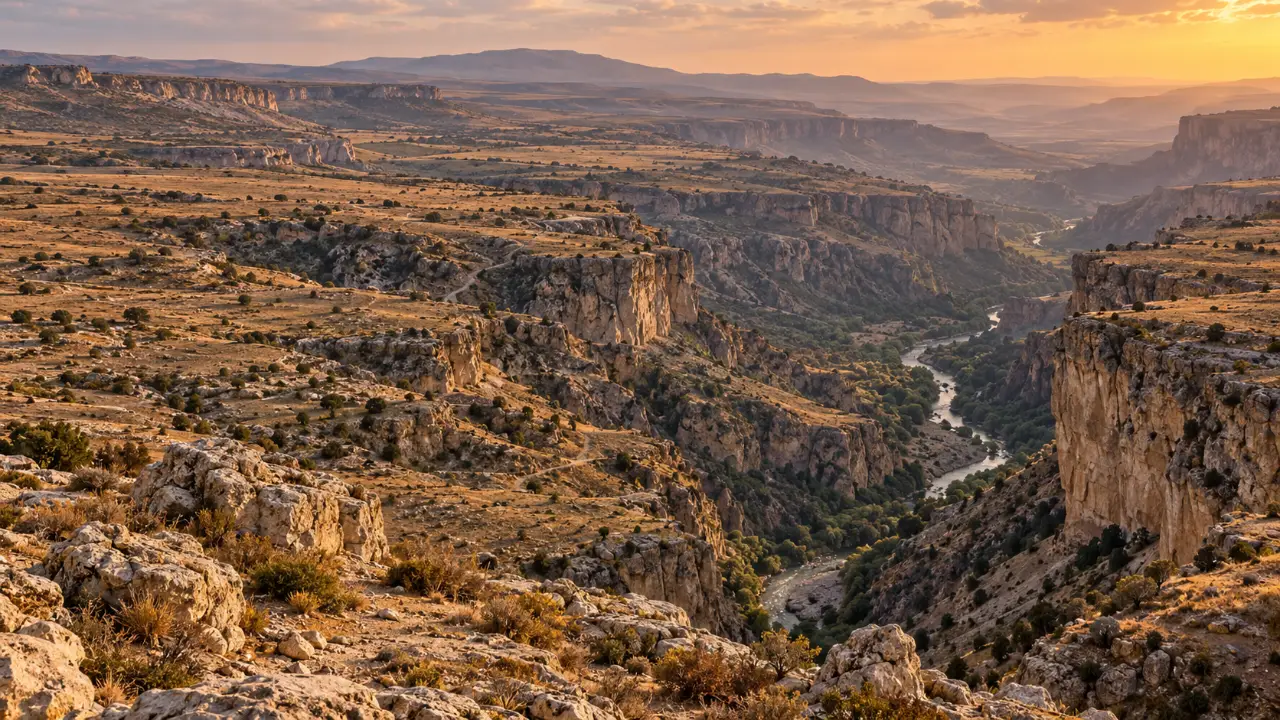
Choosing a battlefield is no minor detail.
Khalid ibn al-Walid relied heavily on the rapid movement of his cavalry.
He needed space that would allow him to maneuver his cavalry from one front to another.
The Yarmouk region is located southwest of Damascus, near the area where the borders of Syria, Jordan, and the Golan Heights meet today.
The terrain there combines:
open plains...
deep valleys...
and steep slopes.
Among the most important are the Yarmouk Valley and the Rakaad Valley.
This terrain played a crucial role in the final stage of the battle.
It provided open spaces that allowed the cavalry to maneuver...
but at the same time makes retreating in certain directions extremely dangerous.
Consequently...
whoever succeeds in controlling the retreat routes can turn defeat into a catastrophe
How large were the two armies?
Islamic historical sources estimated the size of the Muslim army at the Battle of Yarmouk to be between 30,000 and 40,000 fighters,
while the Roman (Byzantine) army was estimated at approximately 240,000 fighters. Estimates of the Muslim army
ranged from 30,000 to 36,000 (and were said to reach 40,000 in some accounts). Commander Khalid ibn al-Walid organized it into kadis (units).
Khalid (may Allah be pleased with him) reorganizes the army
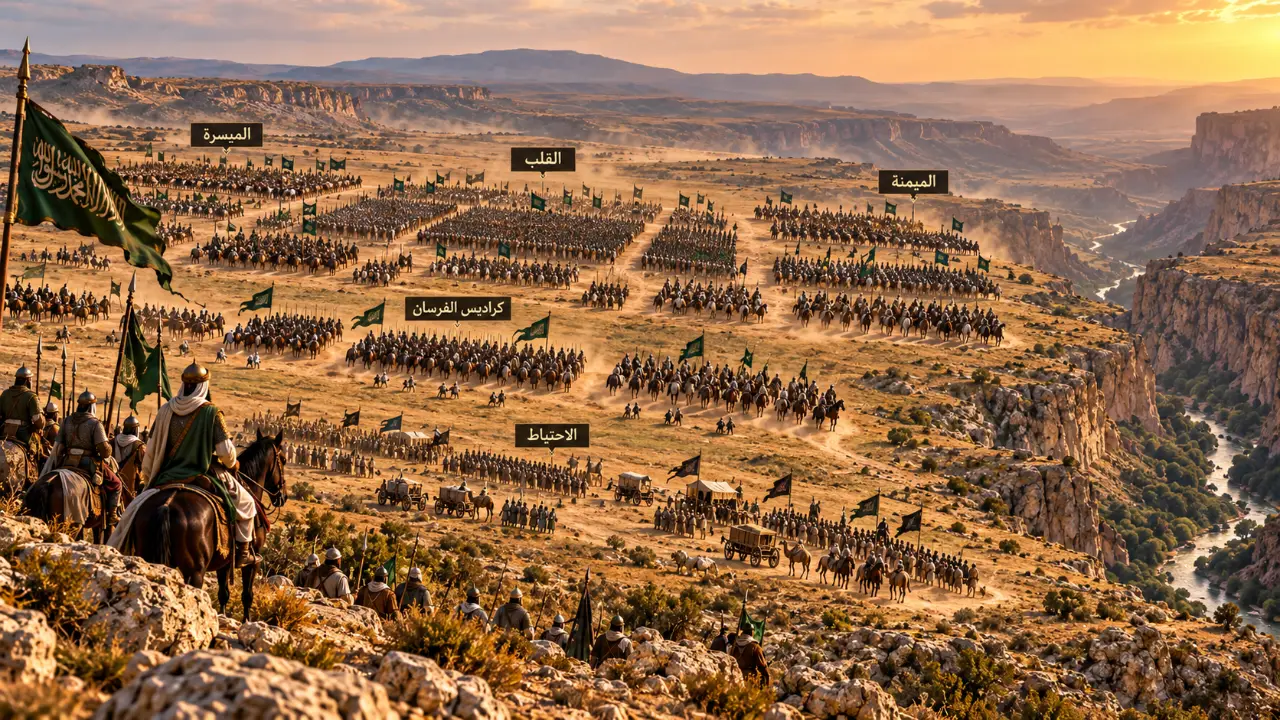
Although Abu Ubaydah ibn al-Jarrah was the commander-in-chief in the Levant during the reign of Caliph Umar ibn al-Khattab, Khalid ibn al-Walid possessed extensive field experience in managing battles.
As the major confrontation drew near, he took on a central role in organizing the army and devising the battle plan.
The army was divided into units and wings.
But the most important element of the plan was the cavalry.
Instead of keeping all the army’s cavalry tied solely to the unit to which they belonged...
Khalid maintained a mobile cavalry force that could be used as a rapid reserve.
Its function was simple but critically important:
If a flank collapsed…
they would move to its aid.
If the Byzantines breached an area…
they would strike them from the flank.
And if an opportunity to attack arose…
they would transform from a relief force into an offensive force.
This mobile force would later become one of the most crucial factors in the battle.
Day One: Duels and Probing
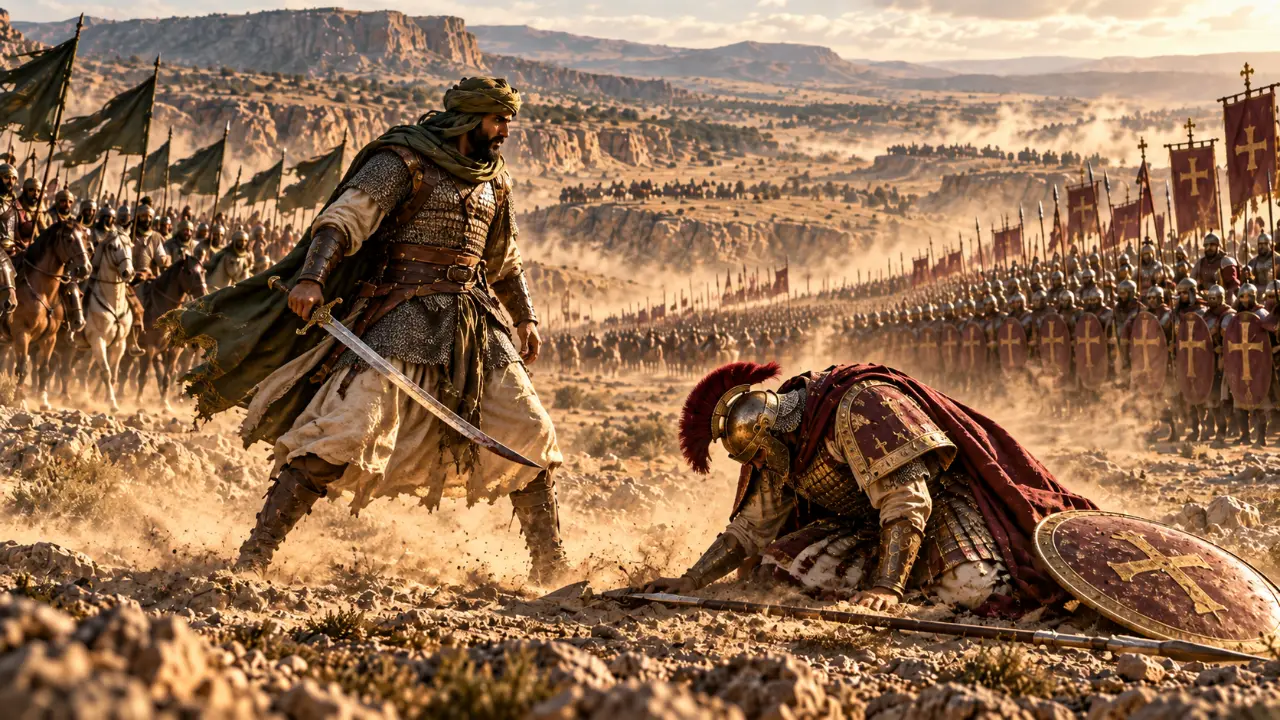
The battle began at sunrise,
when the two armies lined up on the plains of Yarmouk.
The Byzantine plan relied on exploiting their numerical superiority to break through and destroy the Islamic army, while the Muslims relied on a cohesive defensive strategy.
The Duels of the Commanders
: The Byzantine commander George stepped forward and challenged Khalid ibn al-Walid to a duel. A famous exchange took place between them, ending with George converting to Islam, joining the ranks of the Muslims, and fighting alongside them until he was martyred in the same battle.
Several other Roman commanders also came forward to duel, but Muslim heroes such as Abd al-Rahman ibn Abi Bakr prevailed.
The First General Assault:
After midday, with the Romans having lost a number of their commanders in the duels, the Byzantine commander-in-chief, Bahan, ordered the general assault to begin.
Two-thirds of the Byzantine infantry advanced toward the Muslim lines, making heavy use of bows and crossbows.
Result: The Muslim ranks held firm in all sectors, and fierce clashes continued until sunset, at which point the two armies separated and each returned to its camp without either side gaining a clear advantage.
Day Two: The Dawn Attack and the Breakthrough of the Wings
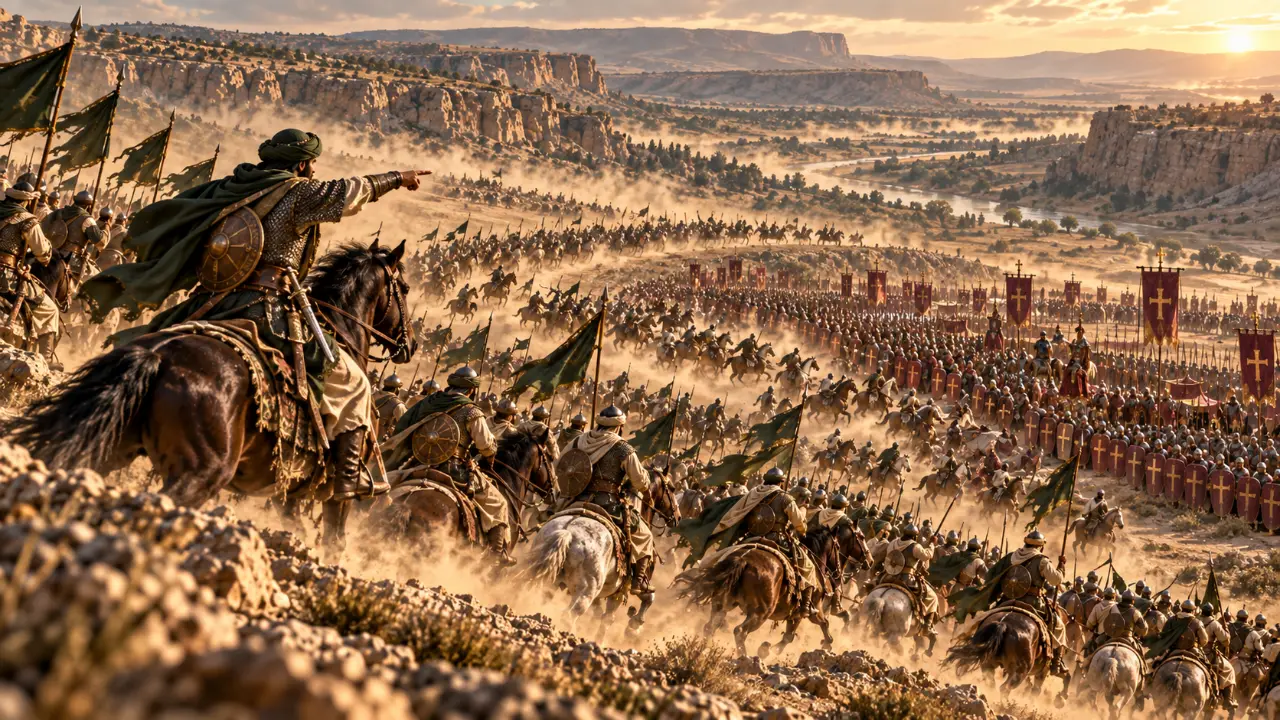
Bahan decided to exploit the element of surprise and launch a very early attack before the Muslims were fully prepared.
The Byzantine Surprise: The Romans attacked at the first light of dawn.
The Islamic army held its ground, but the immense pressure was directed at the flanks (the right and left wings).
A
The Collapse of the Right and Left Wings:
The Romans succeeded in breaching the Muslim right flank (led by Amr ibn al-‘As) and left flank (led by Yazid ibn Abi Sufyan), and the Muslim forces retreated under intense pressure until they reached the women’s encampments in the rear.
The Role of Muslim Women:
This is where the female Companions and other Muslim women (such as Hind bint ‘Utbah and Jiriyah bint Abu Sufyan) stepped in. They stood in the path of the retreating men, brandishing swords and stones, and urged them to return to battle,
prompting the soldiers to charge back into the fray with renewed enthusiasm.
The Mobile Cavalry Unit Intervenes:
Khalid ibn al-Walid saw the critical situation and intervened with the “rapid cavalry unit.” Khalid led a lightning-fast attack on the Roman left flank, which was putting pressure on the Muslim right flank,
while Qais ibn Hubayra led an attack on their other flank.
This tactic succeeded in isolating the Roman infantry from their cavalry, and the Romans were forced to retreat to their original positions as night fell.
Day 3: Focus on the Right Side
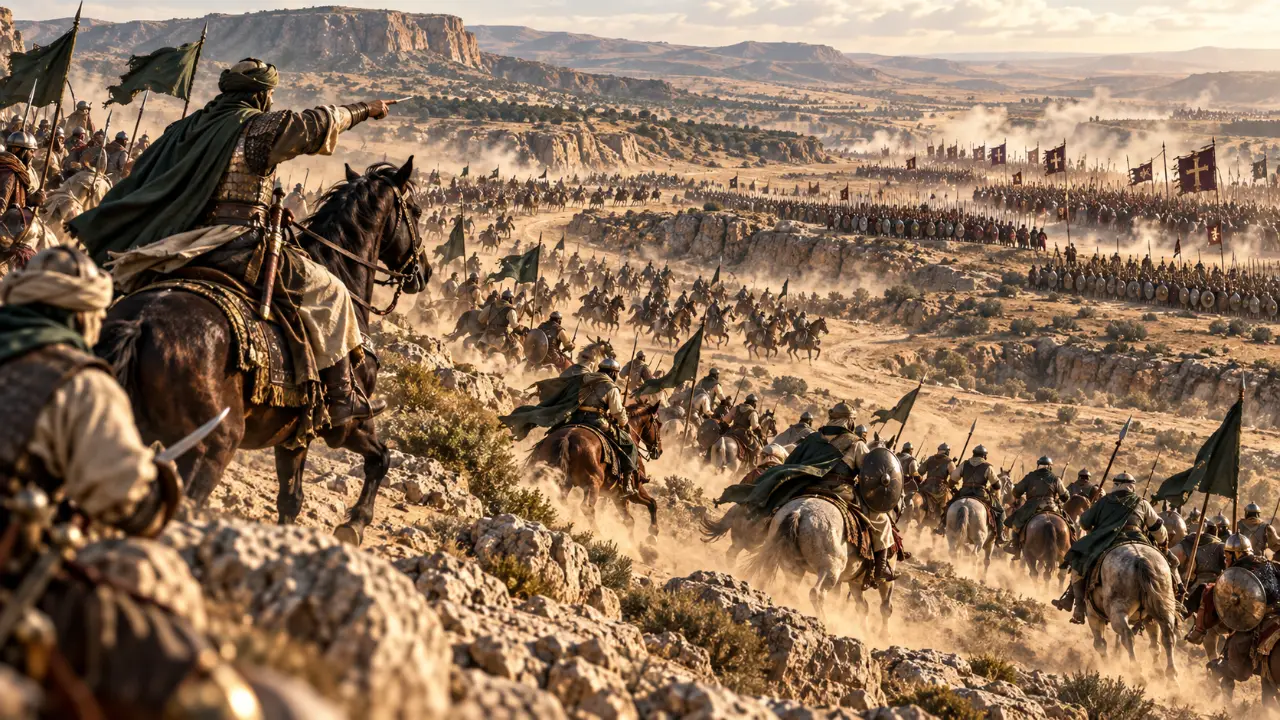
After the failure of the dawn attack the previous day, Bahan decided to adjust his plan by concentrating his entire striking force on a specific point to break the Islamic army.
The Attack on the Right Flank: The Romans concentrated their attack on the Islamic right flank, and more specifically on the point where the right flank met the center.
The goal was to cut off the flank commanded by Amr ibn al-As and Shurahbil ibn Hasana from the rest of the army.
The Second Retreat:
The Romans once again succeeded in forcing the right flank to retreat toward the camps, and the men were once more met with sharp rebukes from the women, who urged them to stand firm.
Khalid’s Surprise Flanking Maneuver:
Khalid ibn al-Walid moved swiftly with his cavalry and executed a clever flanking maneuver in which he attacked the left wing of the Byzantine army (which was putting pressure on the Muslim right flank) from the rear,
while the Muslim infantry attacked from the front.
.
.
The Failure of the Byzantine Plan:
The attacking Byzantine forces were caught in a pincer movement, resulting in the deaths of hundreds of them, while the rest retreated to their initial defensive lines before sunset.
Day Four: The Day of “The Loss of the Eyes” and the Archers
That day was the most violent and bloodiest for the Muslims,
and it became historically known as “The Day of the Helmets” or “The Day of the Blindfold.”
A Rain of Arrows:
Bahan decided to use the Byzantine archers (who were renowned for their accuracy) in an unprecedentedly intensive manner to destroy the Muslims’ morale before the infantry advanced.
.
The Romans fired thousands of arrows at once, to the point that accounts describe the sky as having darkened from the sheer number of arrows.
Severe Injuries: Approximately 7,000 Muslims were wounded in the eyes during this attack,
and the eyes of senior commanders such as Abu Sufyan ibn Harb, al-Mughirah ibn Shu‘bah, and ‘Asim ibn ‘Amr were gouged out.
A Critical Retreat:
The Muslim lines retreated due to loss of visibility and severe injuries.
The Byzantine forces took advantage of the situation and advanced forcefully under cover of the archers’ arrows.
The Valiant “Death Battalion”:
At this critical moment, ‘Ikrimah ibn Abi Jahl stepped forward and shouted, “Who will pledge allegiance to die?”” Four hundred Muslim heroes pledged allegiance to him (including his uncle al-Harith ibn Hisham and Dharar ibn al-Azwar).
This battalion launched a legendary suicide attack into the heart of the Roman army, which completely halted their advance
and allowed Khalid ibn al-Walid to reorganize the ranks and repel the attack, but Akrama’s battalion was almost entirely martyred.
Day 5: Request for a Truce and Skirmishes (August 19, 636 CE)
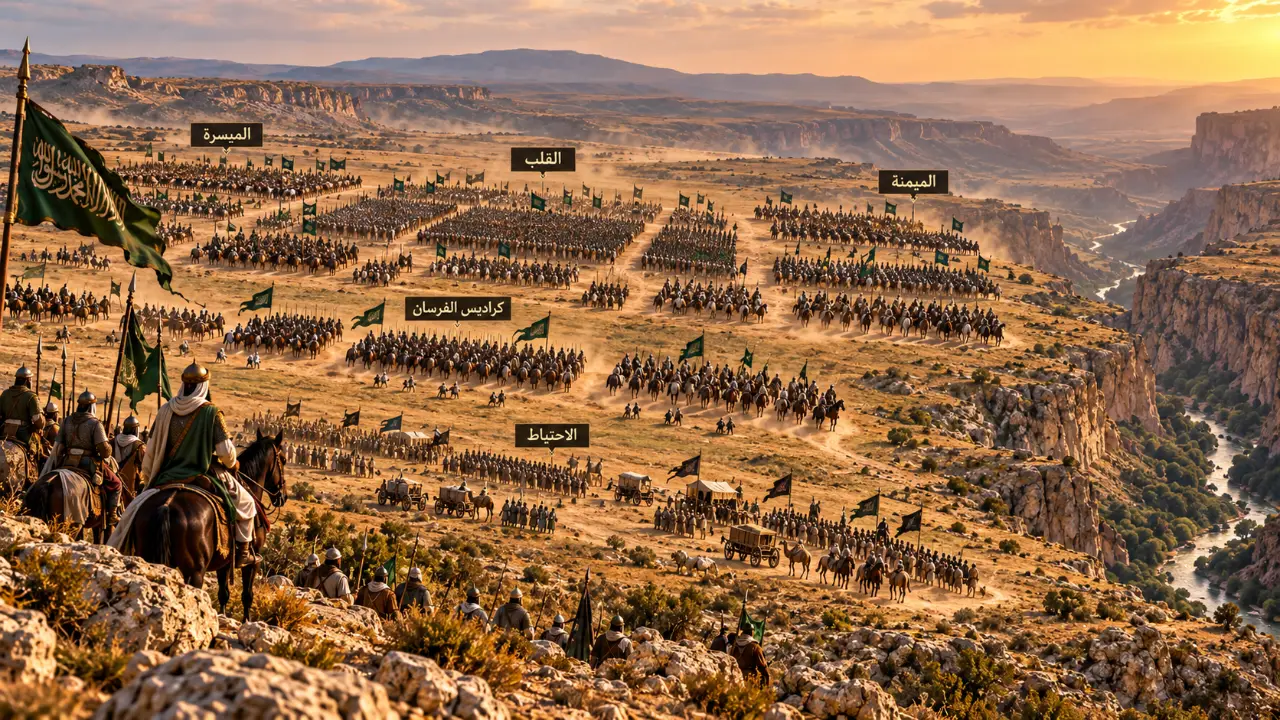
After four days of fierce fighting and heavy losses on both sides,
the morale of the Byzantine army began to collapse as a result of the repeated failure of their plans in the face of Khalid’s genius.
Bahan’s Request for a Truce:
Bahan sent a messenger to Khalid ibn al-Walid asking for a truce and a cessation of fighting for a few days to regroup and negotiate.
Khalid’s astute refusal:
With his military acumen, Khalid ibn al-Walid realized that the Romans were completely exhausted and in a state of utter despair, and that a truce would give them a chance to rest; the Roman messenger received a categorical response from Khalid: “We are eager to bring this matter to a close, and we will not grant you even a single day.”
The Shift to Offense:
Khalid spent the rest of the day completely reorganizing the army, gathering all the scattered cavalry units (numbering about 8,000 horsemen) and transforming them into a unified strike force under his direct command,
deciding to shift from defense to an all-out offensive the following day.
Day Six: The Decisive Blow and the Final Battle
It was the decisive day on which Khalid ibn al-Walid implemented a flanking and encircling strategy that is still taught today in military academies.
The All-Out Islamic Attack: This time, the Muslims launched the attack.
Khalid led his combined cavalry and launched a sweeping attack aimed at completely isolating the Byzantine cavalry from their infantry.
The Flight of the Roman Cavalry:
Khalid succeeded in breaking through the Byzantine cavalry and isolating them; when the Byzantine cavalrymen found themselves encircled and cut off from the infantry, they fled northward into the depths of Byzantine territory,
leaving the infantry behind without any defensive cover.
Blocking the Only Passage (Wadi al-Raqad):
At the same time, Khalid had secretly dispatched a small battalion led by Dharar ibn al-Azur to carry out an extremely dangerous mission:
to seize control of the Wadi al-Rakad bridge,
the only passage through which the Byzantine army could retreat due to the rugged, mountainous terrain.
The Siege and Collapse:
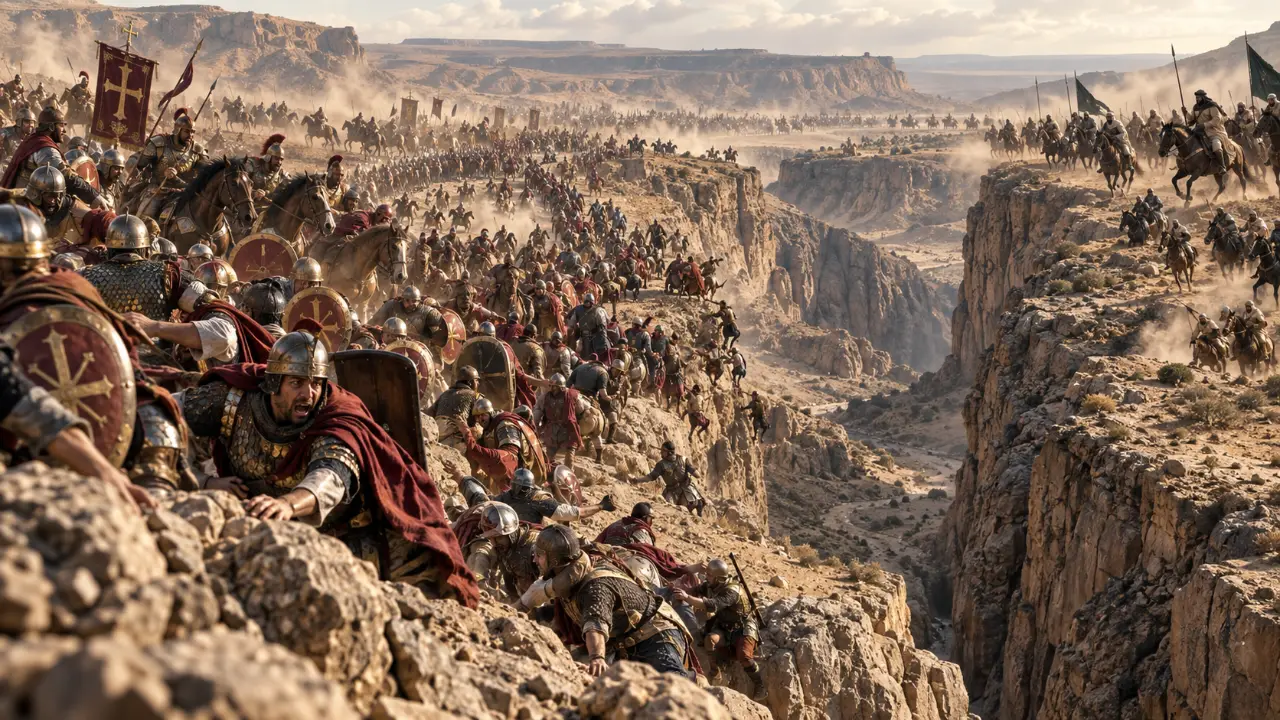
The Byzantine infantry found themselves trapped between the Yarmouk hills and the deep abyss of the valley on one side, and the advancing Islamic army on the other, with their only route of retreat cut off.
Panic gripped the Byzantines, and they began falling in droves into the deep valley (Al-Waqsa).
The battle ended with the complete collapse of the Byzantine army, the death of Theodoros, the commander of the Levant (brother of Emperor Heraclius), and the flight of Bahan, marking the end of Byzantine presence in the Levant.
After Yarmouk
Where was Emperor Heraclius?
Heraclius himself was not leading the battle on the field of Yarmouk.
He was in the north, and the management of the battle on the ground was in the hands of his commanders.
And when news of the defeat reached him...
the emperor realized that the situation in the Levant had changed radically.
Later accounts attribute to him famous farewell remarks regarding Syria.
However, the authenticity of the commonly cited versions of those statements cannot be verified.
What is historically certain is that after Yarmouk, the Byzantines were unable to send another army of equal strength to retake the Levant.
And thus a completely new phase began.
What happened after Yarmouk?
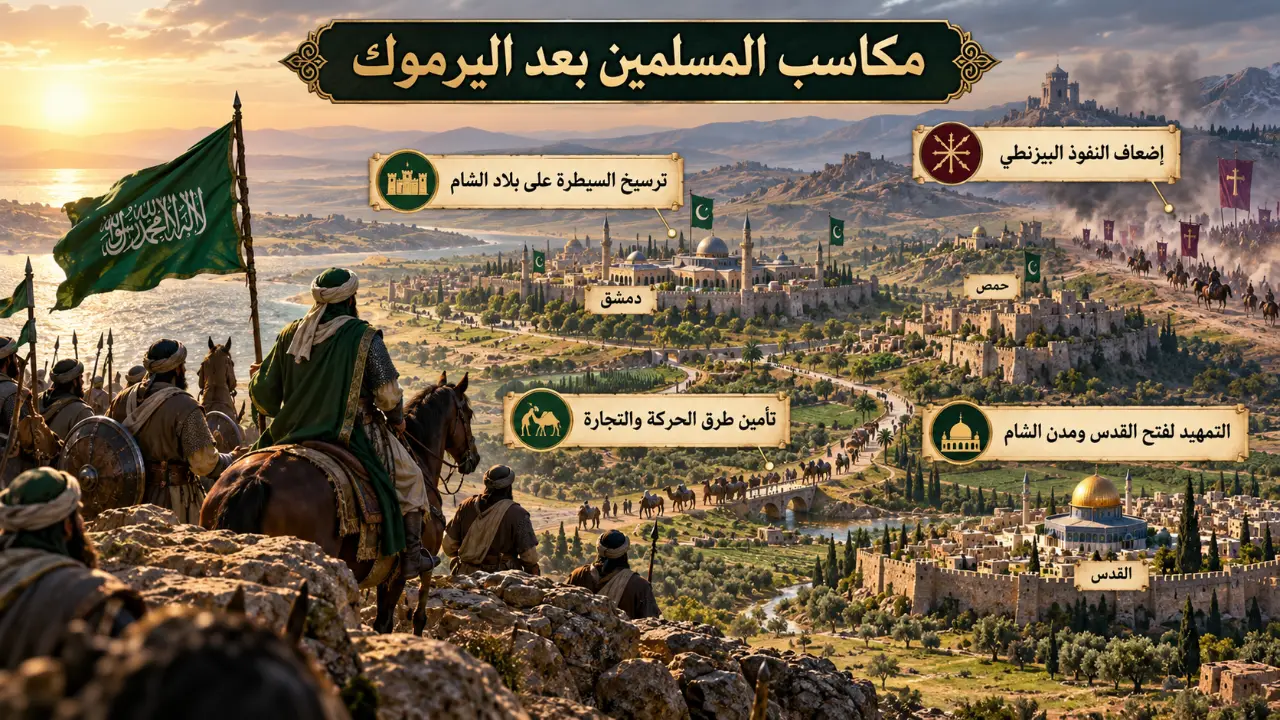
After the victory, the Muslims regained the initiative in the Levant.
The cities and regions from which the Muslims had temporarily withdrawn during the Byzantine mobilization returned to their control.
Operations then continued.
In the following years, Muslim control over Syria and Palestine was consolidated.
Jerusalem came under Muslim rule.
The Muslims then turned their attention to Egypt.
Of course, the Byzantine Empire did not disappear.
It remained a great power for centuries to come.
But its eastern borders changed.
It began to rely increasingly on the Taurus Mountains and the regions of Anatolia as lines of defense against Islamic expansion.