Rules of Worship and Religious Rites
Prayer
Its Conditions, Pillars, and Obligations
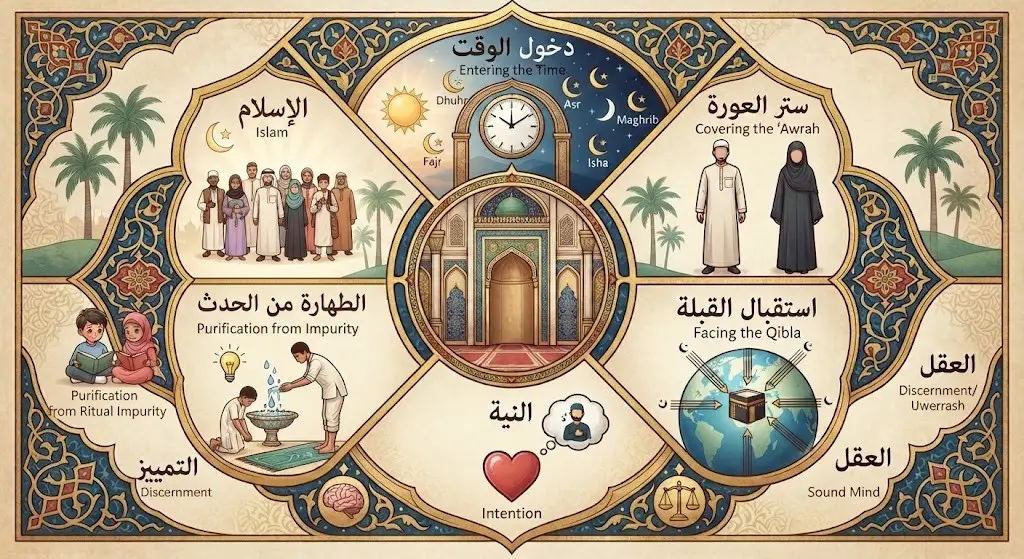
1-Islam: Prayer is not valid for a non-believer.
2-Sanity: Prayer is not valid for someone who is insane or intoxicated to the point of losing their mind.
3-Discernment: Prayer is not valid for a young child who has not reached the age of discernment (usually 7 years old).
4-The onset of the prayer time: Prayer is not valid before the time has begun or after it has ended without a valid excuse.
5-Removal of ritual impurity: By performing wudu’ for minor ritual impurity and ghusl for major ritual impurity.
6-Removal of physical impurity: From the body, clothing, and the place of prayer.
7-Covering the private parts: For men, the private parts extend from the navel to the knees; for women, the entire body except the face and hands must be covered during prayer.
8-Facing the Qiblah: Facing the Kaaba in Mecca.
9-Intention: It is formed in the heart and is specific to each prayer.
The Pillars of Prayer
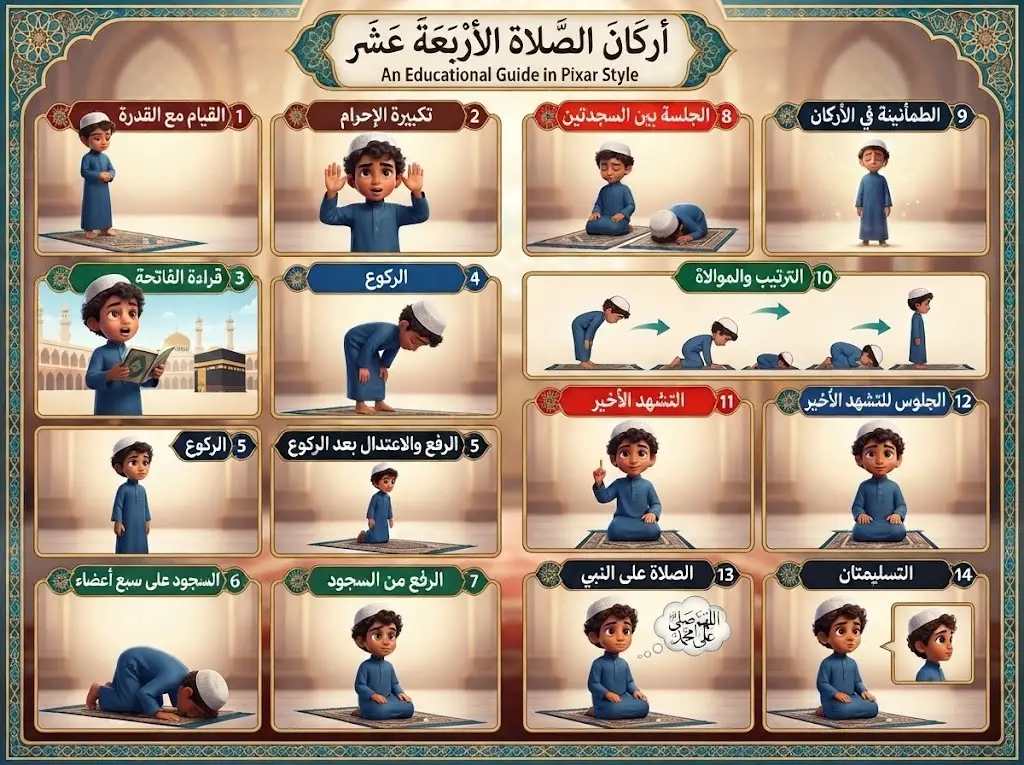
Prayer consists of fourteen pillars according to the majority of jurists and as adopted by scholars
1- Standing upright during obligatory prayers for those who are able: Standing upright during obligatory prayers for those who have no health-related excuses.
2- The Takbir al-Ihram: Saying “Allahu Akbar” at the beginning of the prayer.
3- Reciting Al-Fatihah: It must be recited in every rak’ah by both the imam and those praying alone.
4- Ruku’: Bending forward so that the hands reach the knees.
5-Rising from bowing: Returning to a standing position after completing the bow.
6-Standing upright: Remaining steady in a standing position after rising.
7- Prostration: Placing the seven parts of the body (the forehead, nose, palms, knees, and the tips of the feet) on the ground.
8- Rising from prostration: Rising from the first prostration to sit.
9. Sitting Between the Two Prostrations: Sitting steadily between the first and second prostrations.
10. Tranquility: Remaining still and steady for the duration of the required remembrance in each physical pillar (such as bowing, prostration, and standing upright).
11-The Final Tashahhud: Reciting the prescribed text of the tashahhud during the final sitting of the prayer.
12-Sitting for the Final Tashahhud: Remaining seated while reciting the final tashahhud.
13- Praying for the Prophet ﷺ: Saying “O Allah, send blessings upon Muhammad…” after the final Tashahhud.
14- The Two Greetings: Saying “Peace be upon you and the mercy of Allah” twice to conclude the prayer
Obligations of Prayer
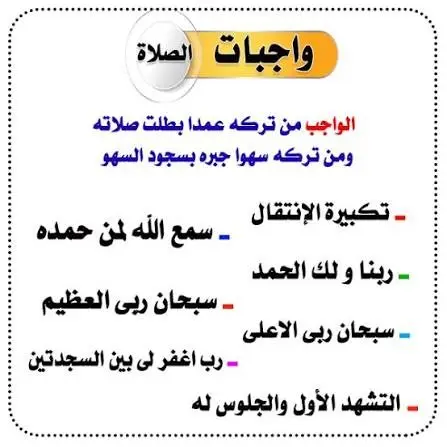
The Eight Obligations of Prayer:
1- All takbirs other than the takbir of ihram (such as the takbirs of ruku’, sujud, and standing up).
2- Saying, “Sami’a Allahu liman hamidah” by the imam and the person praying alone (who is praying by himself).
3- Saying, “Our Lord, to You be praise,” by everyone (the imam, those following the imam, and those praying alone).
4- Saying, “Glory be to my Lord, the Great,” once while bowing.
5- Saying, “Glory be to my Lord, the Most High,” once while prostrating.
6. Saying, “O Lord, forgive me,” once between the two prostrations.
7. The first Tashahhud.
8. Sitting for the first Tashahhud.
Things That Invalidate Prayer
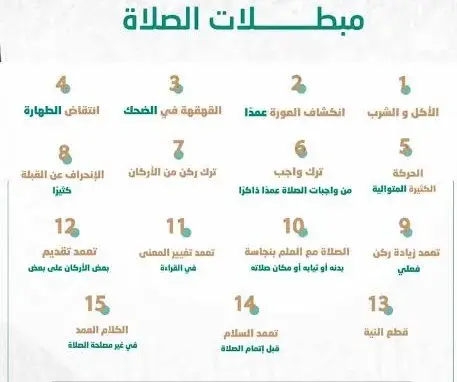
1. Deliberately neglecting the conditions for the validity of prayer
Breach of ritual purity: such as the occurrence of minor or major ritual impurity during prayer (e.g., passing gas or urinating).
Deliberately exposing private parts: if the person praying continues to expose them despite being able to cover them.
Excessive deviation from the qiblah: Intentionally turning one’s back to it or turning one’s entire body away from it.
The presence of known impurity: Intentionally praying while there is impurity on the body, clothing, or prayer area without removing it.
2. Intentionally omitting or adding pillars and obligatory acts
Intentionally omitting a pillar: such as intentionally omitting ruku’, sujood, or the recitation of Al-Fatihah.
Intentionally adding an actual pillar: such as intentionally performing ruku’ twice in a single rak’ah.
Performing some pillars before others: Deliberately disrupting the prescribed order of the prayer.
Deliberately omitting an obligation: Such as intentionally omitting the first Tashahhud while being aware of the ruling.
Interruption of the intention: When the worshipper intends in his heart to exit the prayer and interrupt it while it is still in progress.
3. Actions and Prohibitions Outside the Prayer
Intentional speech: Speaking in everyday language for purposes unrelated to the prayer, while being fully aware and mindful.
Intentional eating or drinking: Whether a lot or a little.
Laughing out loud (giggling): As for a mere silent smile, it does not invalidate the prayer, even if it diminishes one’s reverence.
Excessive, repeated movements without necessity: such as repeatedly fiddling with one’s clothes or body in a way that disrupts the proper form of the prayer.
Intentionally saying the closing salutation before completing the prayer: if the worshipper says the closing salutation while knowing that he has not yet finished the prayer.