Rules of Worship and Religious Rites
Umrah Step by Step
An Illustrated Guide to Performing Umrah as the Prophet ﷺ Did: From preparation, the miqat, intention, and talbiyah, to tawaf and sa’i, through to shaving the head or cutting the hair and exiting the state of ihram.
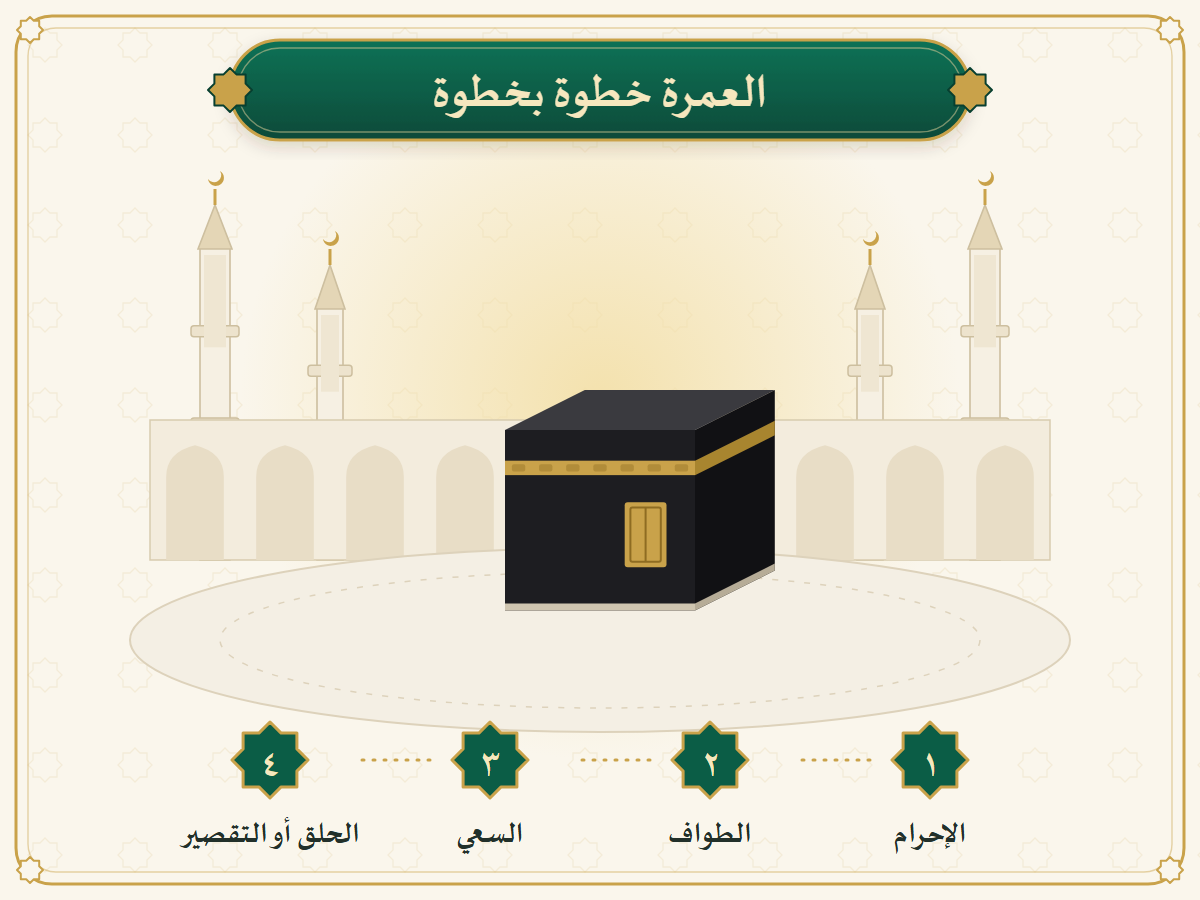
Umrah, linguistically, means “visit”; in Islamic law, it refers to the act of worshiping Allah by entering ihram, followed by circumambulating the Kaaba (Tawaf), then performing the Sa’i between Safa and Marwa, and finally shaving the head or shortening the hair.
Allah, the Exalted, says: ﴿And complete the Hajj and ‘Umrah for Allah﴾ [Al-Baqarah: 196]
The Prophet ﷺ said: “One ‘Umrah to another serves as expiation for what lies between them, and an accepted Hajj has no reward except Paradise.” [Agreed upon]
He ﷺ also said: “An ‘Umrah in Ramadan is equivalent to a Hajj.” [Agreed upon]
It is obligatory once in a lifetime according to some scholars, and a strongly recommended Sunnah according to others; anything beyond that is voluntary, and it may be performed at any time of the year.
Umrah consists of four stages, which you will learn about in the pages of this story:
1. Entering ihram from the miqat with the intention and the talbiyah.
2. Circling the Kaaba seven times (tawaf).
3. Walking between Safa and Marwa seven times (sa’i).
4. Shaving or cutting the hair short, which marks the end of the Umrah.
Preparing for Ihram
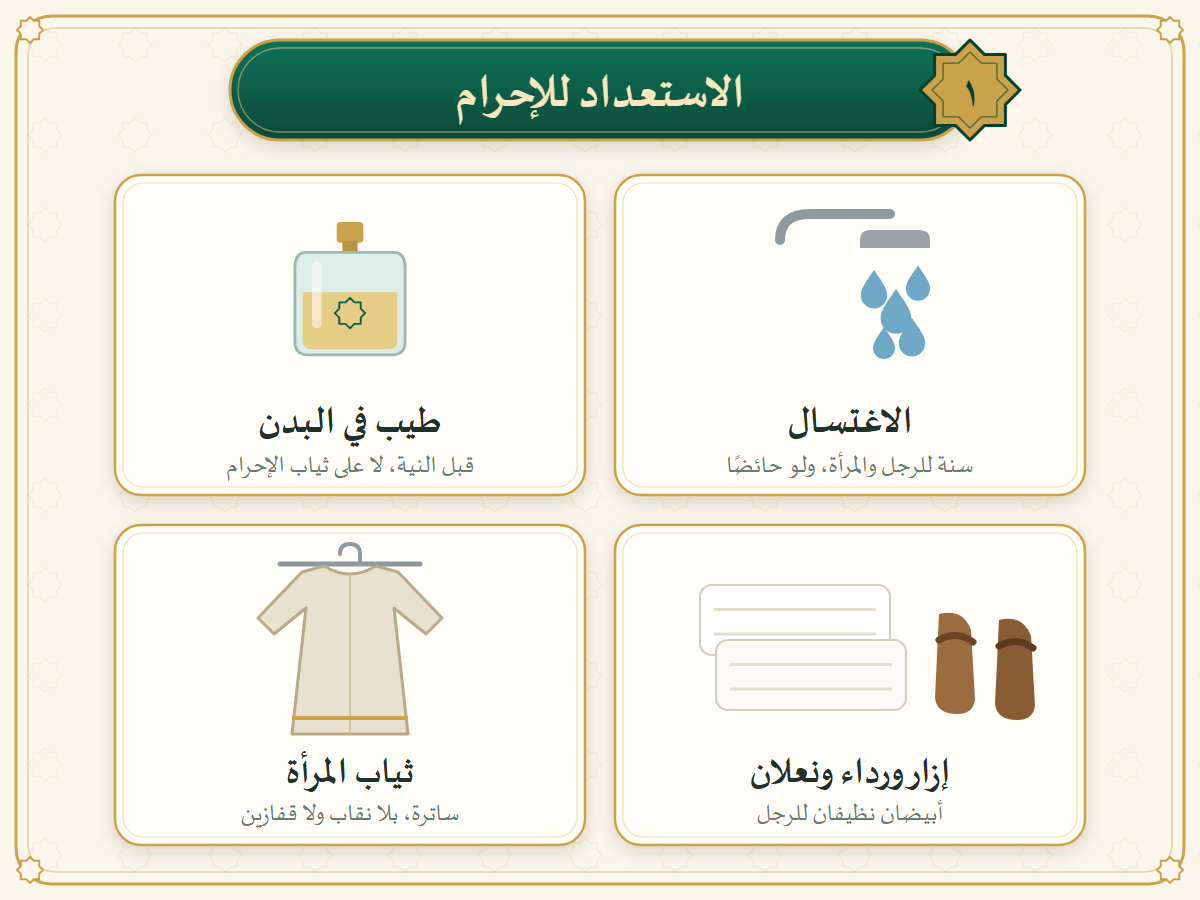
Before reaching the miqat, prepare yourself as the Prophet ﷺ prescribed:
• Take a ritual bath (ghusl) as for janabah; this is Sunnah for both men and women, including menstruating women and those in the postpartum period. The Prophet ﷺ instructed Asma’ bint Umays, when she was in the postpartum period, to take a ritual bath and enter ihram [Narrated by Muslim].
• Groom yourself by trimming your fingernails and mustache and removing any hair that is permitted to be removed, if necessary.
• A man should apply perfume to his body (his head and beard) before making the intention to enter ihram, while not yet wearing the ihram garments. ‘Aishah, may Allah be pleased with her, said: “I used to apply perfume to the Messenger of Allah ﷺ for his ihram before he entered the state of ihram” [Agreed upon].
Ihram Attire:
• For men: an izar (loincloth) and a rida’ (cloak), preferably white and clean, along with sandals. He should not wear form-fitting garments such as shirts or pants, nor should he cover his head.
• For women: They may wear whatever modest, non-revealing clothing they wish; there is no specific color required for ihram, but they must not wear a niqab or gloves. The Prophet ﷺ said: “A woman in ihram should not wear a niqab or gloves” [Narrated by al-Bukhari], and she should cover her face with her headscarf when non-mahram men pass by her.
Prayer Times: When Ihram Begins
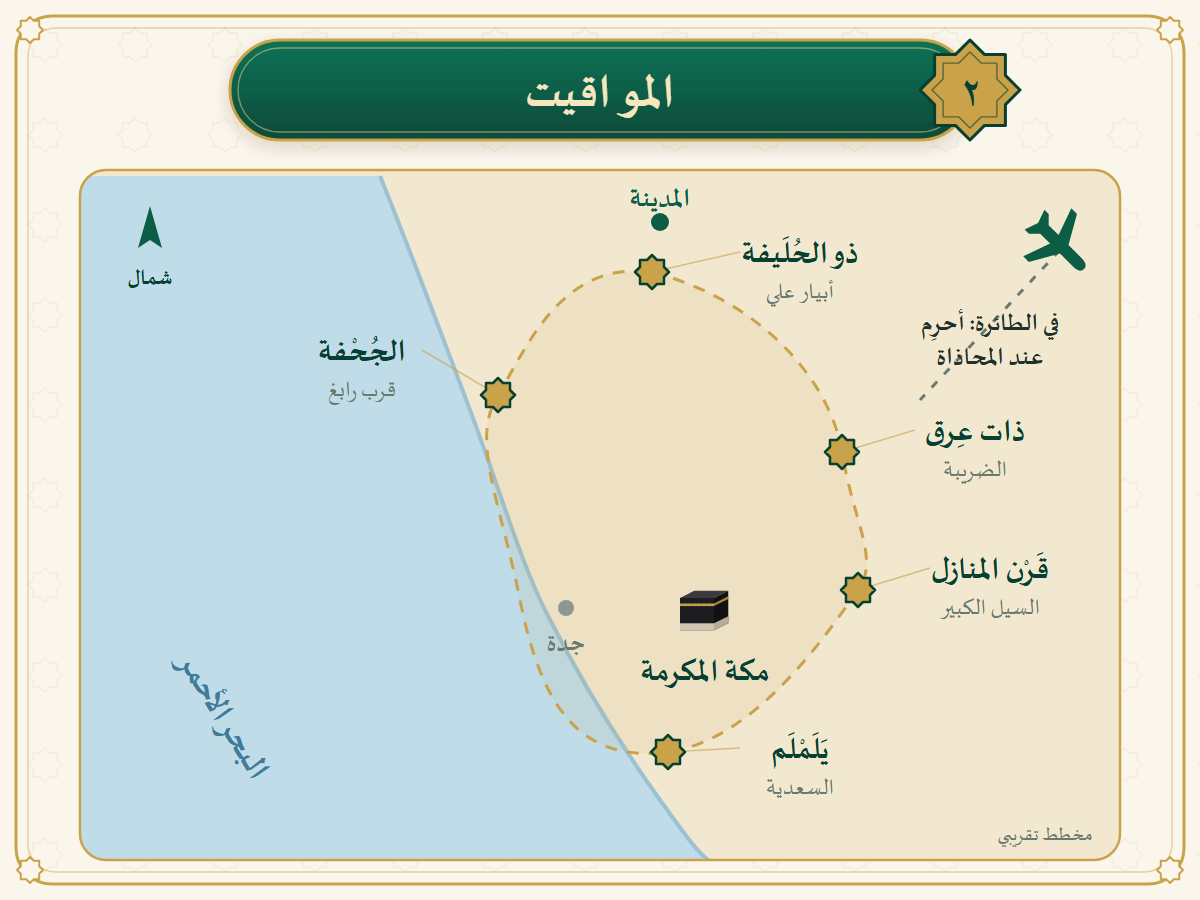
Miqat: The place beyond which a person intending to perform Umrah may not go unless in the state of ihram. The Prophet ﷺ designated these places and said: “They are for them, and for those who come to them from outside their communities, among those who intend to perform Hajj and Umrah.” [Agreed upon]:
• Dhu al-Hulayfah (Abyar Ali): For the people of Madinah and those passing through it; it is the farthest from Makkah.
• Al-Juhfah (near Rabigh): For the people of Syria, Egypt, and the Maghreb, and those coming from their direction.
• Qarn al-Manazil (Al-Sail al-Kabeer, adjacent to Wadi Mahram): for the people of Najd and Ta’if, and those coming from their direction.
• Yalamlam (Al-Sa’diyah): For the people of Yemen and those coming from their direction.
• Dhat ‘Irq (Al-Dharibah): For the people of Iraq and those coming from their direction.
• Whoever resides below the miqats enters ihram from their place of residence, and the people of Mecca go out for ‘Umrah to the Hil, such as Al-Tan’im, as the Prophet ﷺ instructed ‘A’ishah, may Allah be pleased with her [Agreed upon].
• A traveler by airplane enters ihram when the aircraft reaches the miqat while in the air; he should perform ghusl and put on his ihram garments before boarding or while on the plane, and make his intention upon reaching the miqat. He should not delay entering ihram until Jeddah, as it is within the miqats.
Intention and Talbiyah
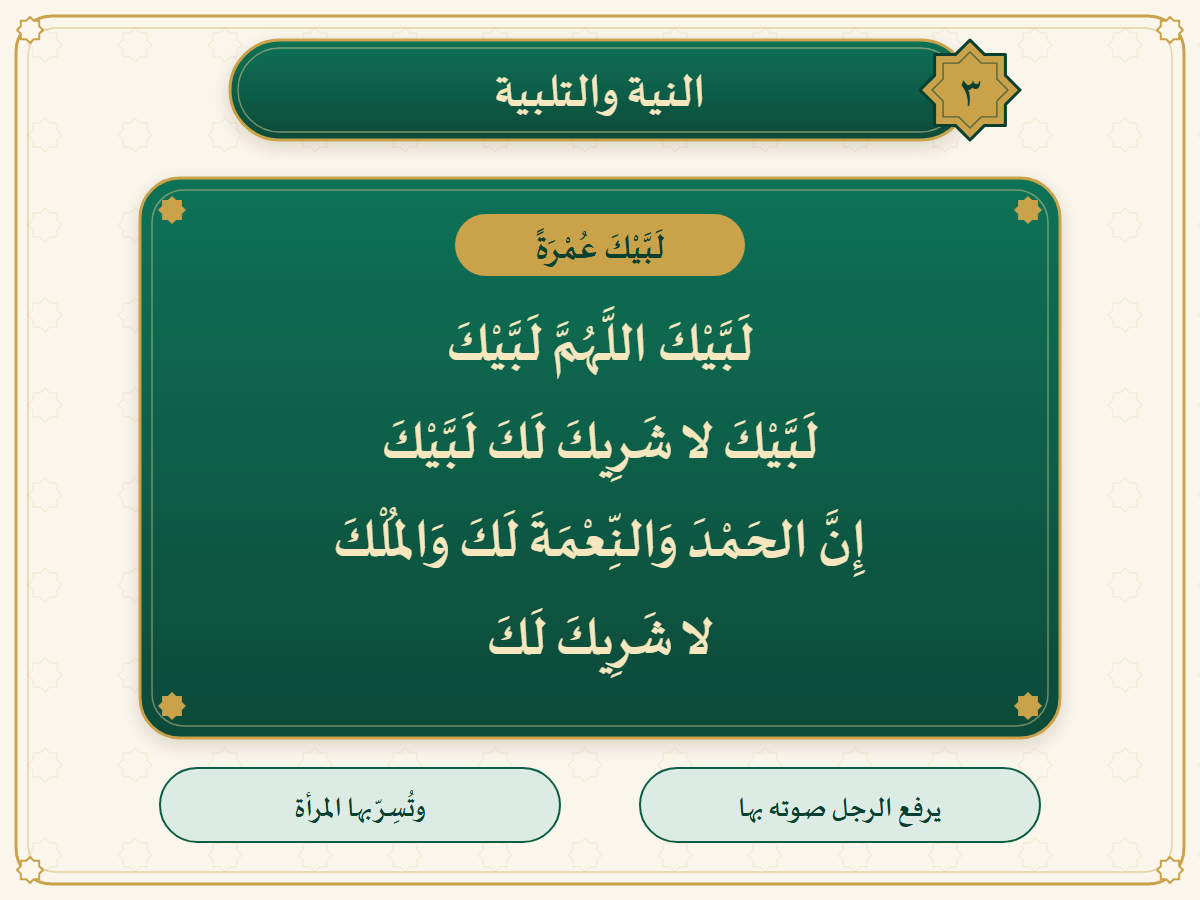
When you reach the miqat and have prepared yourself, intend in your heart to enter the state of umrah, and say: “Labbayk umrah” or “O Allah, Labbayk umrah.”
If it coincides with the time for an obligatory prayer, enter ihram after praying; for the Prophet ﷺ entered ihram after praying Dhuhr [Narrated by Muslim].
Whoever fears an obstacle that might prevent him from completing his ‘Umrah—such as illness or something else—should make a condition upon entering ihram by saying: “If an obstacle prevents me, then my exit from ihram will be wherever that obstacle occurs” [Agreed upon, from the hadith of Duba’ah, may Allah be pleased with her].
Then he should recite the Talbiyah of the Prophet ﷺ:
“Labbayk, O Allah, Labbayk. Labbayk, there is no partner with You; Labbayk. Indeed, all praise, blessings, and sovereignty belong to You; there is no partner with You” [Agreed upon]
• A man should raise his voice when reciting the Talbiyah, while a woman should lower her voice just enough so that she and those next to her can hear her.
• One should recite it frequently on the way to Mecca and cease reciting it once the Tawaf begins.
Prohibitions During Ihram
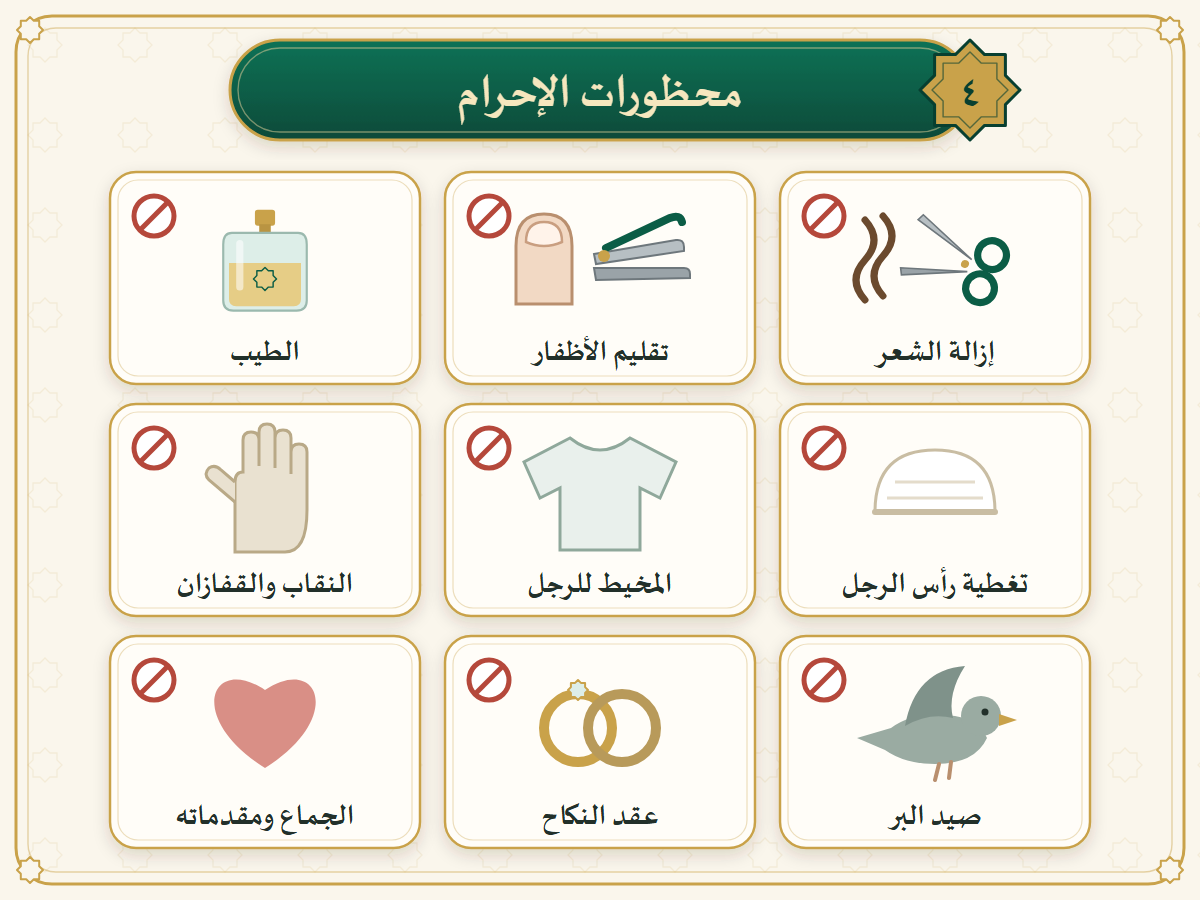
As soon as you form the intention, you become in a state of ihram, and the following are prohibited until you exit ihram:
1. Removing hair from the head or body by shaving, cutting, or plucking.
2. Trimming the fingernails.
3. Applying perfume to the body, clothing, or food and drink.
4. A man covering his head with something that fits snugly, such as a hat or turban; however, an umbrella or a car roof is permissible.
5. A man wearing form-fitting clothing, such as a shirt or pants.
6. A woman wearing a niqab and gloves.
7. Killing land game or assisting in its killing.
8. Performing a marriage contract for oneself or for another.
9. Sexual intercourse and its preliminaries, which is the gravest of these.
• Whoever wears such items or applies perfume out of forgetfulness or ignorance incurs no penalty according to the correct view, but must remove them as soon as he remembers or becomes aware; the Prophet ﷺ ordered a man who had entered ihram wearing a jubah with perfume on it to take it off and wash off the perfume, but did not order him to pay a penalty [Agreed upon].
• Whoever is compelled to do any of these things—such as shaving his head due to illness—must offer an expiation: fasting for three days, feeding six poor people, or slaughtering a sheep; Allah, the Exalted, says: ﴿Then there is a ransom: fasting, charity, or a sacrifice﴾ [Al-Baqarah: 196].
Entering the Grand Mosque
• It is recommended, if possible, to perform ghusl before entering Mecca; Ibn ‘Umar, may Allah be pleased with him, used to perform ghusl before entering it, and it is reported that the Prophet ﷺ did so [agreed upon].
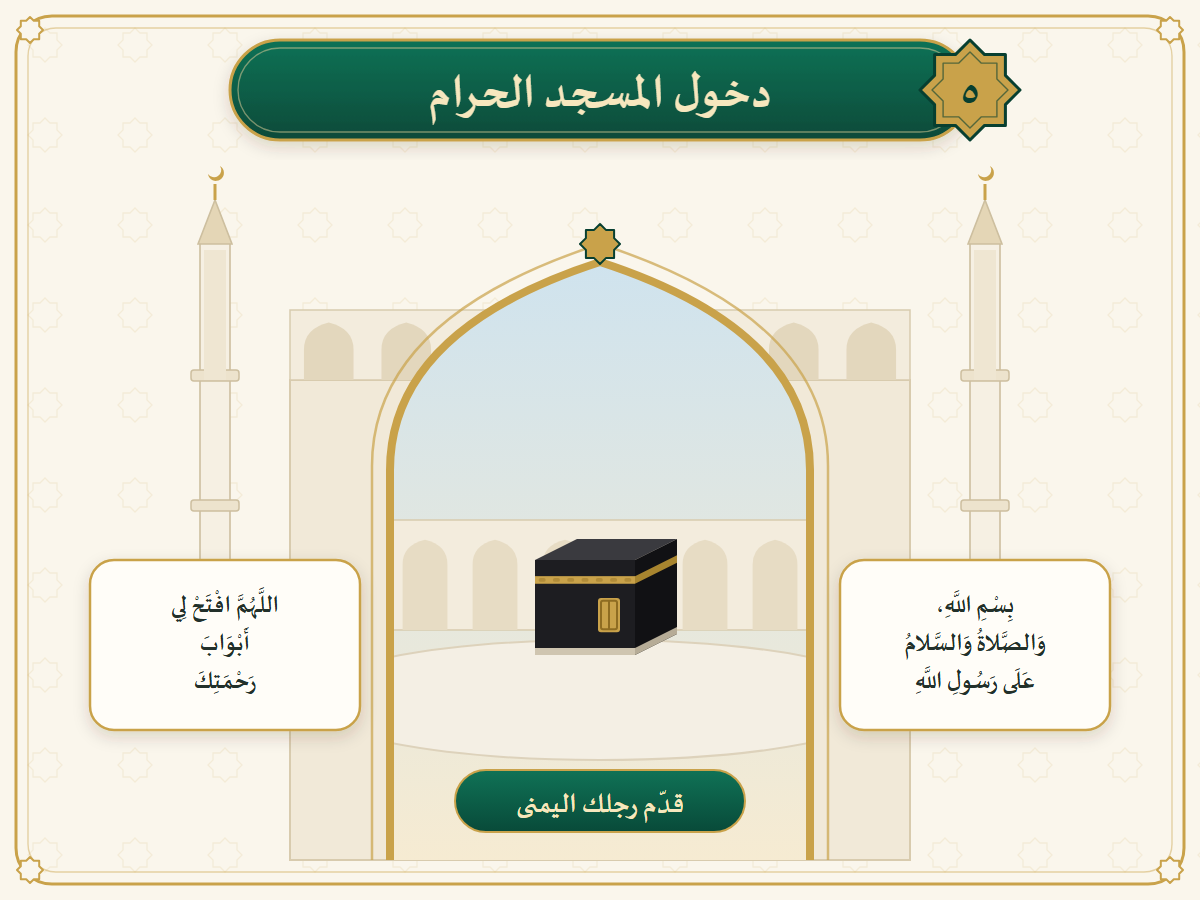
• Enter the Grand Mosque with your right foot first, and say:
“In the name of Allah, and may peace and blessings be upon the Messenger of Allah. O Allah, open for me the gates of Your mercy.”
• There is no specific, established supplication from the Prophet ﷺ to be recited upon seeing the Kaaba; so supplicate to Allah as you wish.
• Whoever wishes to perform the Tawaf may begin with it; the Tawaf suffices in lieu of the greeting of the mosque.
• Then proceed to the Black Stone to begin the Tawaf, and stop reciting the Talbiyah upon starting it.
Tawaf: A Step-by-Step Guide
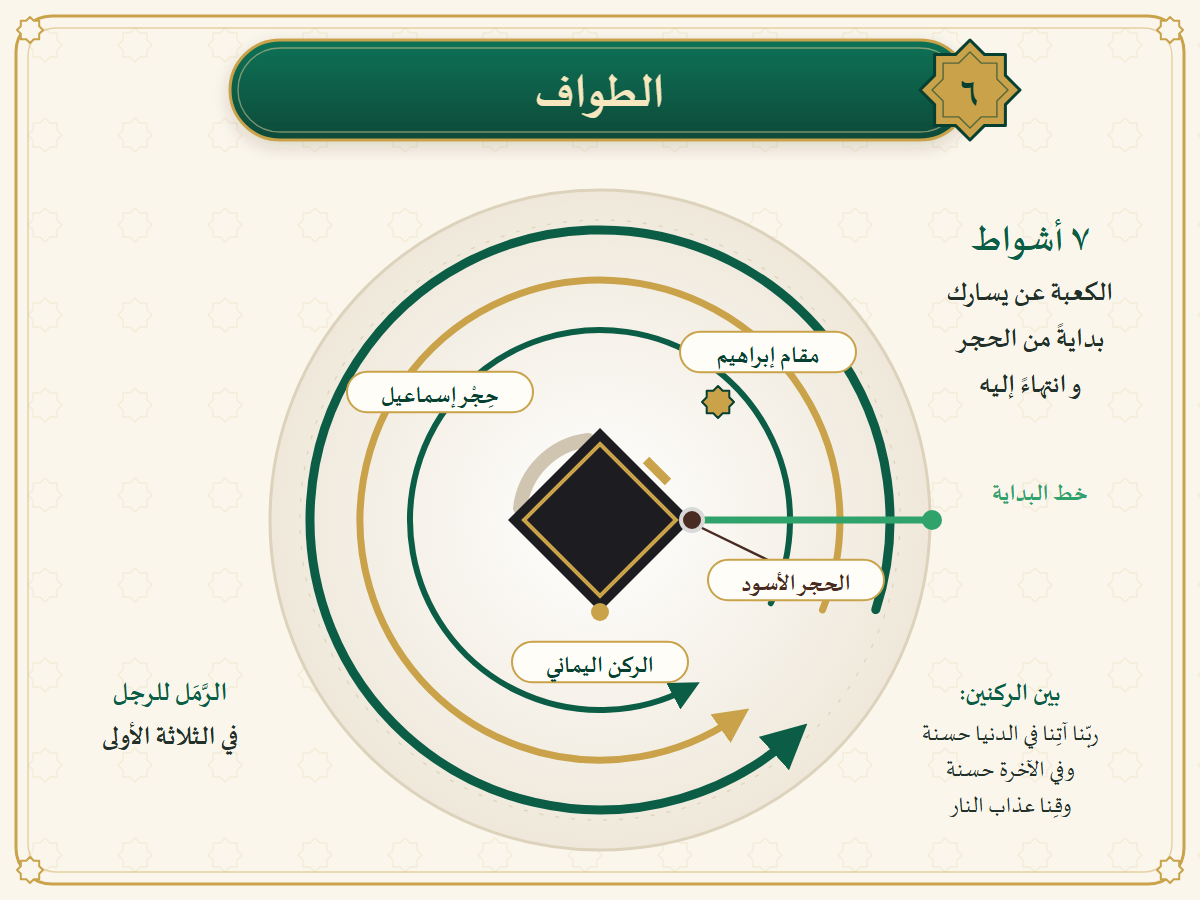
• It is recommended for a man during this tawaf to perform al-idtab: placing the center of his cloak under his right armpit and its ends over his left shoulder, so that his right shoulder remains exposed throughout the seven circuits, then covering it when he is finished.
• Begin at the Black Stone and end there, with the Kaaba on your left.
• Face the Black Stone at the start of the Tawaf and kiss it if possible, or touch it with your hand and then kiss your hand; if that is not possible, point to it with your right hand and say: “Allahu Akbar,” and do not kiss your hand after pointing. Ibn ‘Umar, may Allah be pleased with him, used to say when touching it: “Bismillah, Allahu Akbar.”
• It is recommended for a man to perform “ramal” during the first three circuits—walking briskly with short, quick steps—and to walk normally during the remaining four.
• When you reach the Yemeni Corner, touch it with your hand if possible without kissing it, and do not point toward it if you are unable to do so.
• Between the Yemeni Corner and the Black Stone, say: ﴿Our Lord, grant us good in this world and good in the Hereafter, and protect us from the punishment of the Fire﴾ [Narrated by Abu Dawud].
• Each time you reach the Black Stone, one circuit ends and another begins; so say “Allahu Akbar” there at the start of each circuit.
• Perform the Tawaf from behind the Wall of Ishmael (al-Hutaym); it is part of the Kaaba, and if one performs the Tawaf from inside it, that circuit is not valid.
Etiquette and Supplications of Tawaf
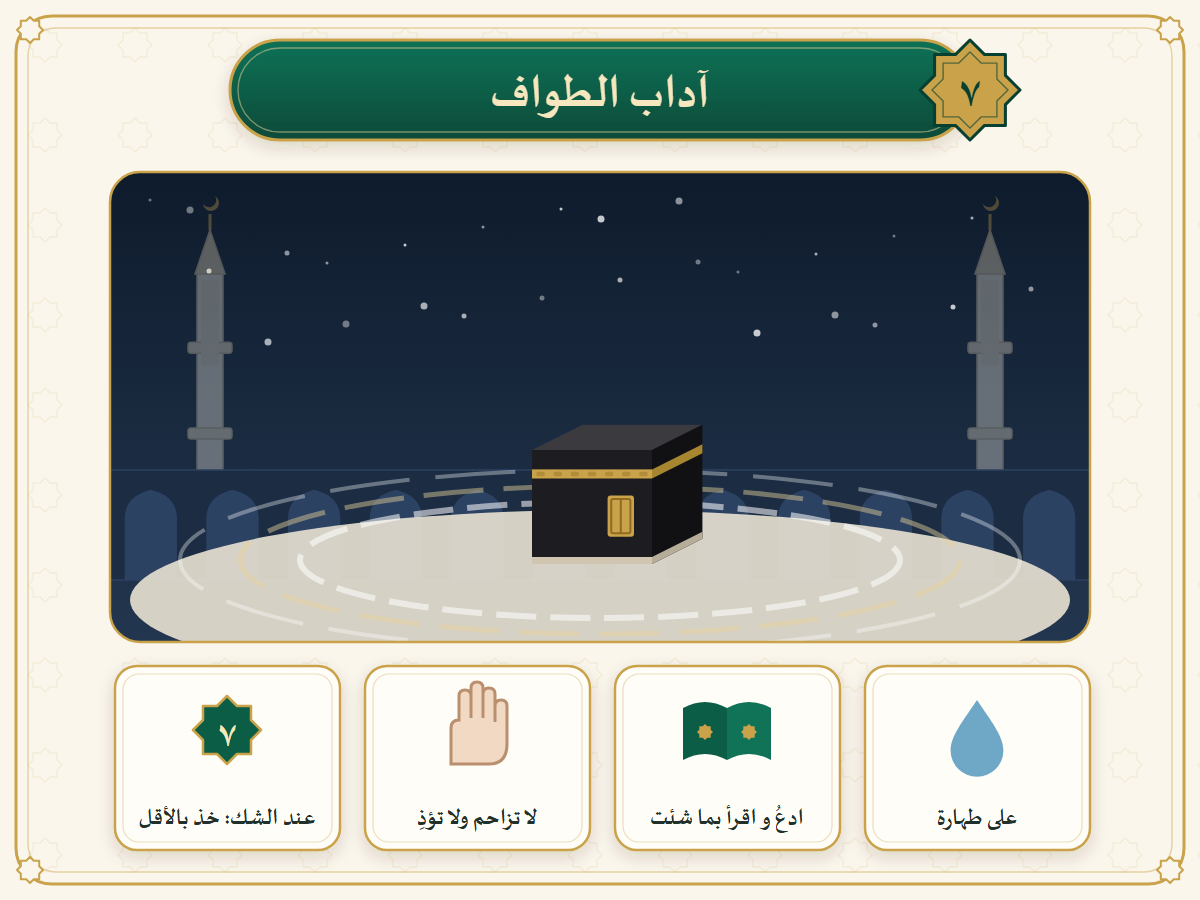
• There is no specific supplication for each circuit; rather, remember Allah, supplicate to Him as you wish, recite the Quran, and recite general supplications.
• According to the majority of scholars, ritual purity from both types of impurity is a prerequisite for tawaf, and a menstruating woman must not perform tawaf until she becomes pure; the Prophet ﷺ said to Aisha, may Allah be pleased with her: “Do as the pilgrim does, except do not perform Tawaf around the Ka’bah until you have become pure.” [Agreed upon].
• Covering the private parts is obligatory during Tawaf, just as it is during prayer.
• If you are unsure of the number of circuits, assume the lower number, as that is the surer option.
• If the call to prayer is given while you are performing tawaf, pray with the congregation, then resume your tawaf from where you left off.
• Do not jostle or harm anyone in order to reach the Black Stone or the Corner; the Sunnah is not attained by harming Muslims, and a gesture is sufficient.
• Be humble and offer abundant supplication for yourself, your parents, and the Muslims; for you are in the holiest place on earth.
The Two Rak'ahs of Tawaf and Zamzam Water
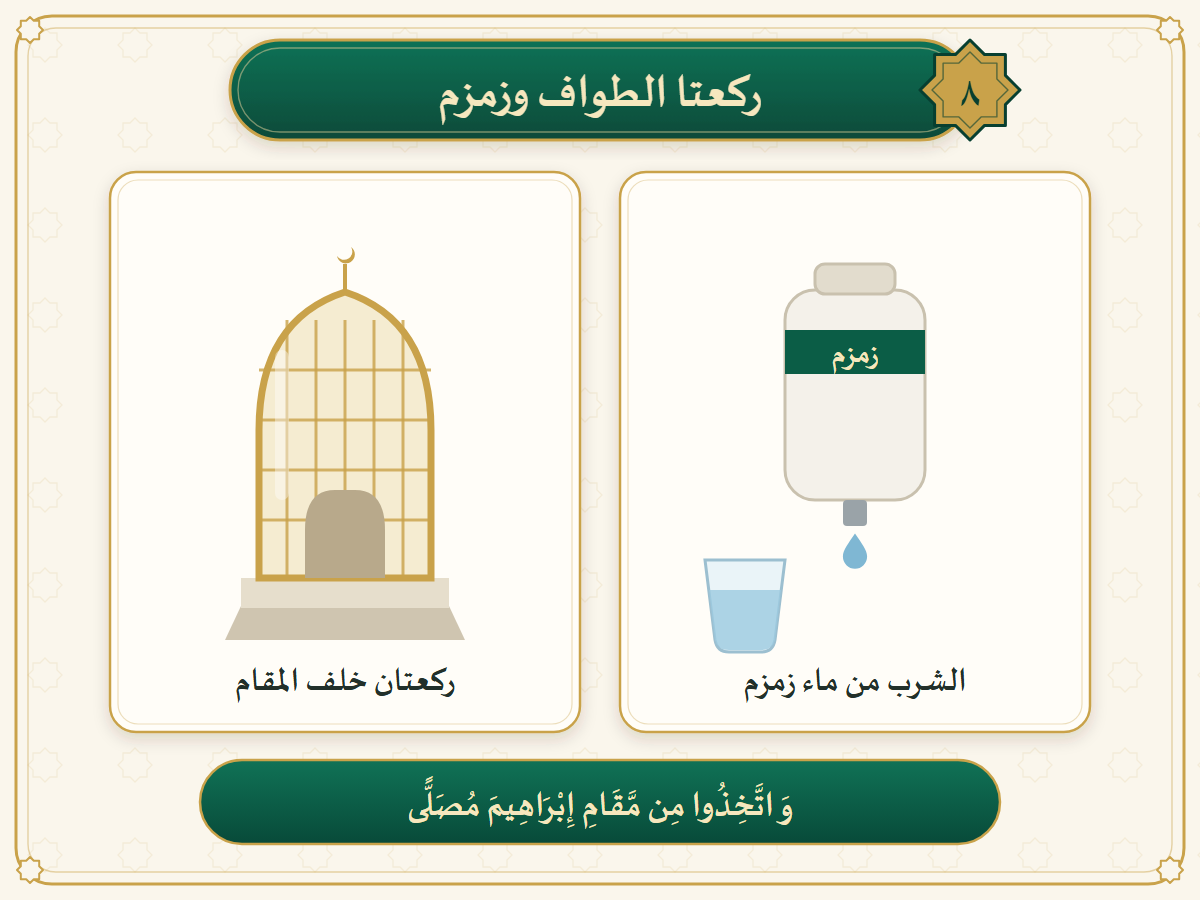
• When you have completed the tawaf, cover your right shoulder and proceed to the Maqam Ibrahim (peace be upon him) while reciting: ﴿And take the Station of Abraham as a place of prayer﴾ [Al-Baqarah: 125].
• Pray two rak’ahs behind the Maqam if possible; in the first rak’ah, after reciting Al-Fatihah, recite: ﴿Say, “O you who disbelieve!”﴾, and in the second: ﴿Say, “He is Allah, the One and Only.”﴾, as the Prophet ﷺ did [Narrated by Muslim]. If the crowd is too dense, pray them anywhere in the mosque.
• Then drink from the water of Zamzam and pour some over your head, as the Prophet ﷺ did [Narrated by Ahmad], and he said: “The water of Zamzam is for whatever it is drunk for” [Narrated by Ibn Majah and Ahmad]. So drink with a righteous intention and make whatever supplication you wish.
• It is recommended, if possible, to return to the Black Stone and touch it before heading out to the Sa’i, as the Prophet ﷺ did [Narrated by Muslim].
Sa’i: Starting from Al-Safa
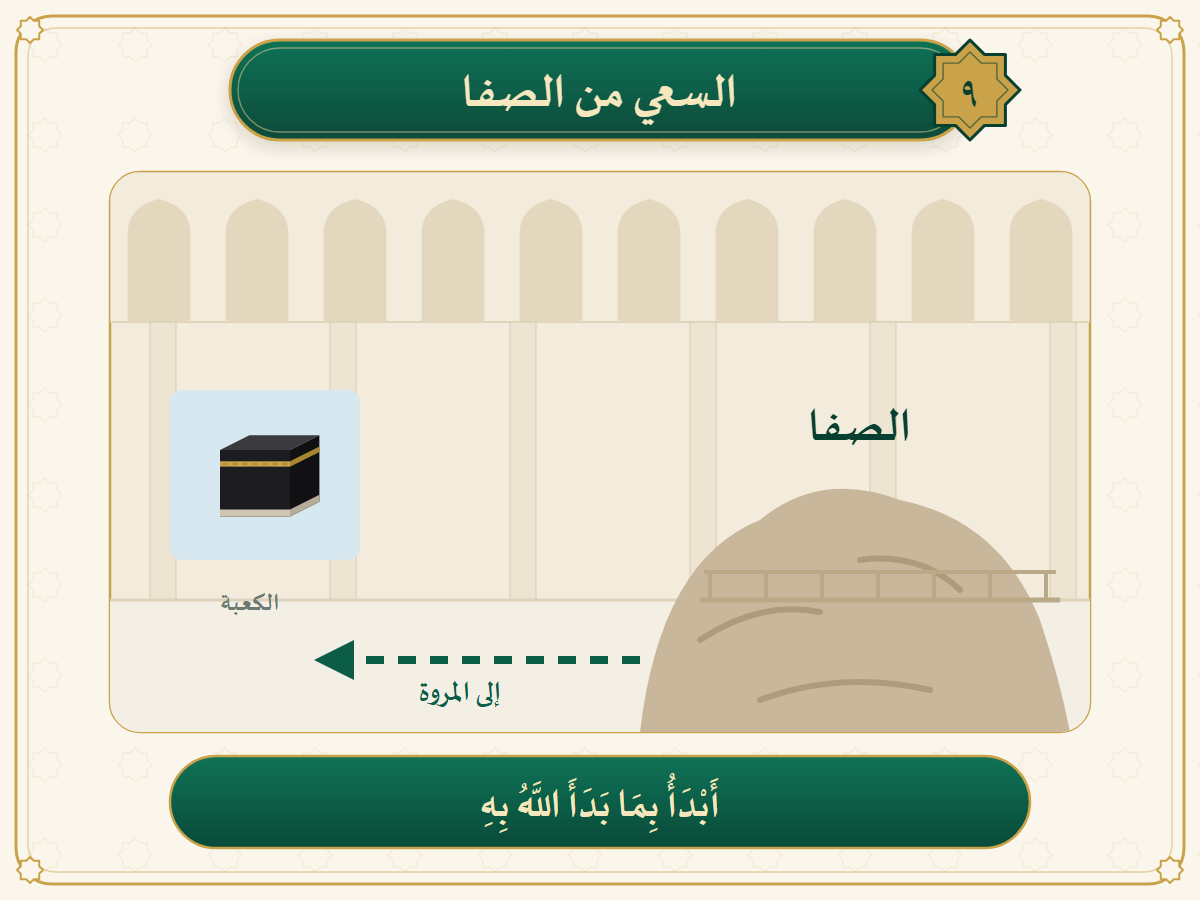
• Head toward the Sa‘i. When you approach the Safa, recite: ﴿Indeed, the Safa and the Marwa are among the symbols of Allah﴾ [Al-Baqarah: 158], and say: “I begin with what Allah began with,” but only at the start of the Sa’i.
• Climb up the Safa until you can see the Ka’bah, if possible, face it, raise your hands, glorify Allah, affirm His Oneness, and say:
“There is no god but Allah alone; He has no partner. To Him belongs the dominion, and to Him belongs all praise. He is Powerful over all things. There is no god but Allah alone; He fulfilled His promise, granted victory to His servant, and defeated the confederates all by Himself.”
• Repeat this invocation three times, and in between, make whatever supplication you wish [Narrated by Muslim from the hadith of Jabir, may Allah be pleased with him].
• Then descend toward Al-Marwah to begin the first circuit.
Sa‘i: The Seven Circuits
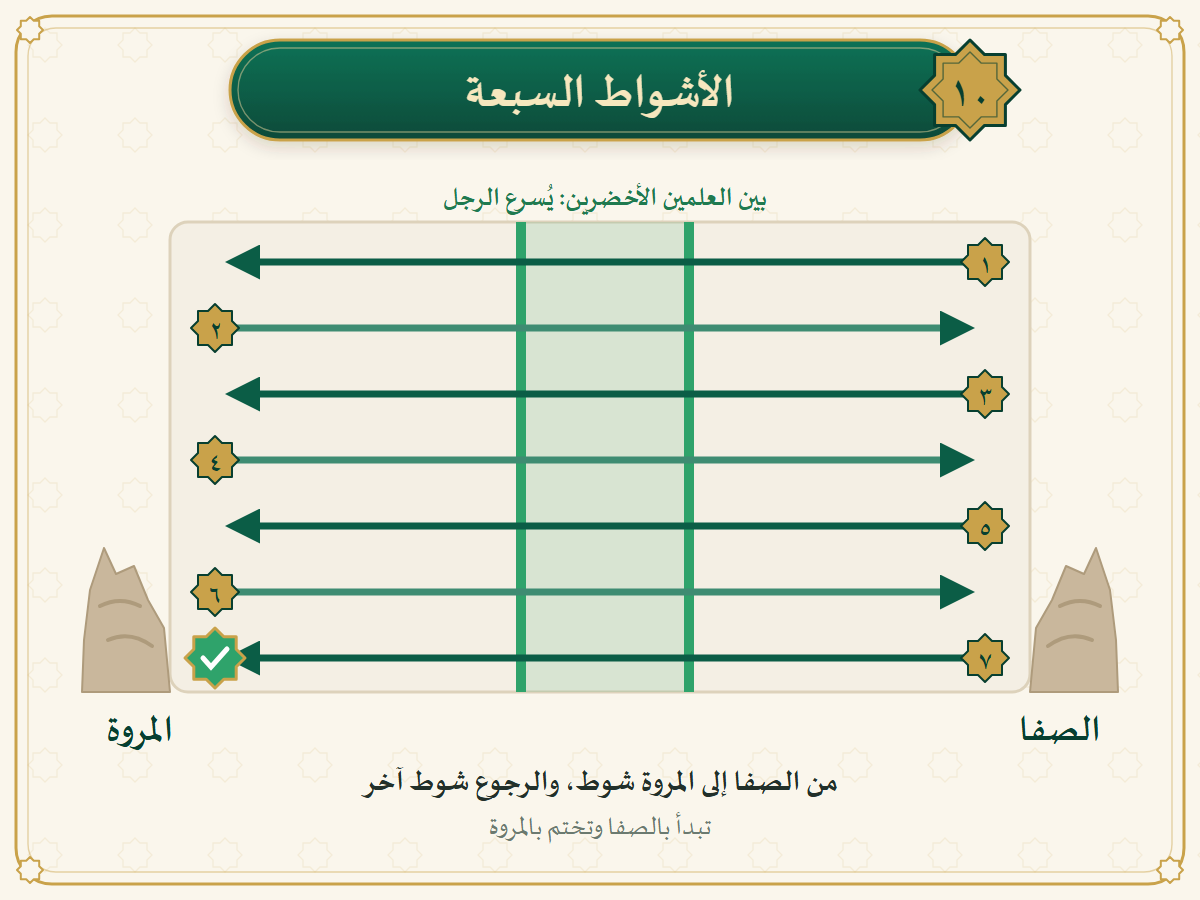
• Walk from al-Safa to al-Marwah. When you reach the first green marker (the green lights), men should walk briskly in a vigorous manner until they reach the second green marker, then continue walking. Women, however, should walk at a normal pace without hurrying.
• When you reach Al-Marwah, climb up to it, face the qiblah, and recite the same remembrance and supplications you recited at Al-Safa.
• The journey from Al-Safa to Al-Marwah is one lap, and from Al-Marwah to Al-Safa is another lap; you begin at Al-Safa and conclude at Al-Marwah after seven laps.
• Invoke Allah as you wish during your Sa‘i, remember Him, and recite the Qur’an. Ibn Mas‘ud and Ibn ‘Umar, may Allah be pleased with them, used to say during the Sa‘i: “O Lord, forgive and have mercy; indeed, You are the Most Exalted, the Most Generous.”.
• Purity is not a prerequisite for the Sa’i, though it is preferable; if a woman begins her menstrual period after the Tawaf, she may still perform the Sa’i.
Shaving or Trimming the Hair and Letting It Grow Long
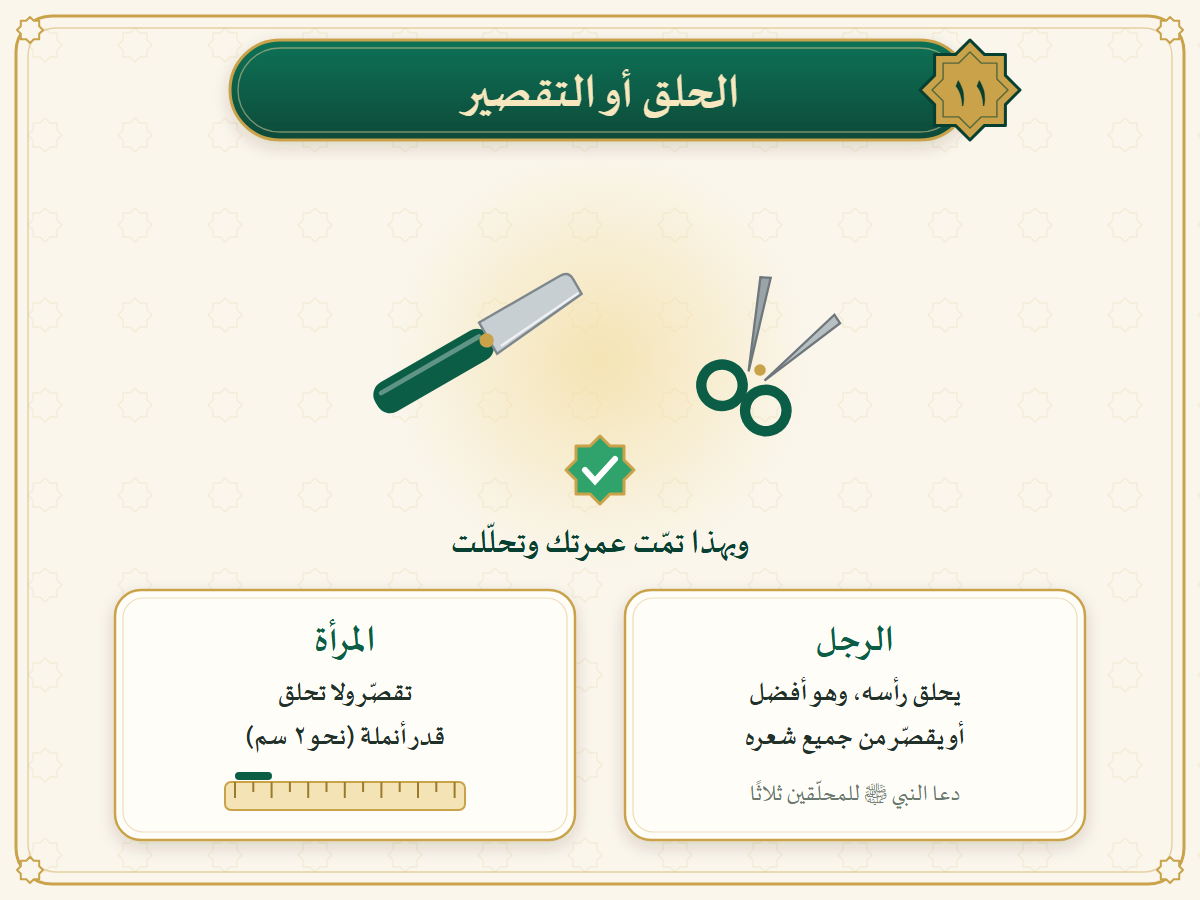
• After the Sa‘i, a man should shave his head or trim all the hair on his head, and shaving is preferable; for the Prophet ﷺ prayed three times for those who shaved and once for those who trimmed [Agreed upon].
• For one who performs ‘Umrah close to the Hajj as a “mutamatti’,” shortening the hair is preferable, so that enough hair remains to be shaved during the Hajj.
• Women should trim their hair but not shave it: they should gather their hair and trim the ends by the length of a fingernail (about 2 cm); the Prophet ﷺ said: “There is no shaving required of women; rather, what is required of women is to trim their hair.” [Narrated by Abu Dawood].
• With this, your ‘Umrah is complete, and everything that was prohibited to you while in the state of ihram is now permitted.
So praise Allah for what He has made easy for you, ask Him to accept it, and pray earnestly that He will accept it from you and make it a righteous ‘Umrah.
The Pillars, Obligations, and Sunnahs of Umrah
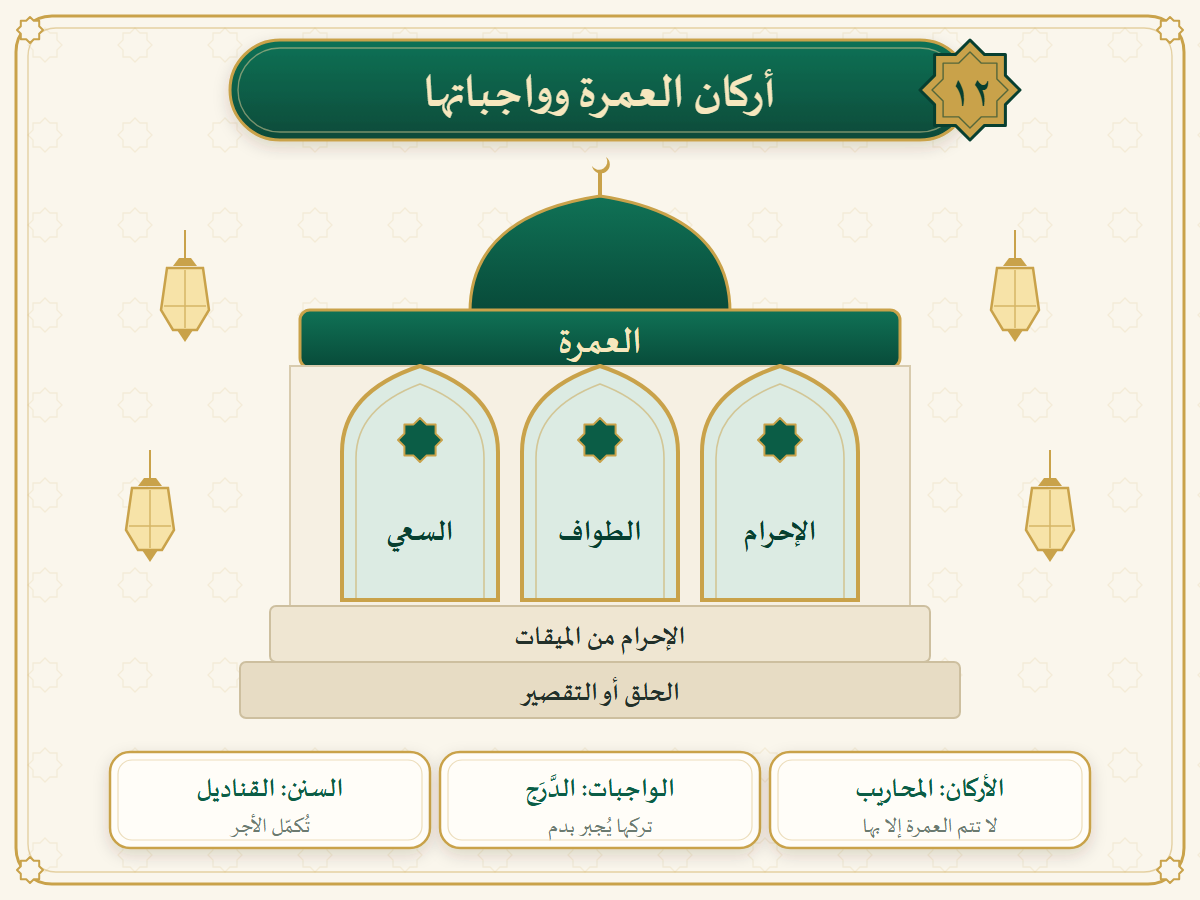
Its Pillars—Umrah is not valid without them:
1. Ihram: The intention to enter the state of ihram.
2. Tawaf around the Kaaba seven times.
3. Sa’i between Safa and Marwa seven times.
Obligations — Whoever omits them must make up for them by offering a sacrifice (a sheep slaughtered in Mecca and distributed to the poor of the Haram):
1. Entering ihram from the miqat.
2. Shaving the head or cutting the hair short.
Sunnah acts—one who omits them incurs no penalty but misses out on their reward:
• Bathing and applying perfume before entering ihram, and wearing a white izar and rida.
• Reciting the talbiyah, with men raising their voices when doing so.
• For men, draping the right shoulder and walking briskly during the tawaf.
• Touching and kissing the Black Stone, and touching the Yemeni Corner.
• Performing two rak’ahs of Tawaf behind the Maqam and drinking Zamzam water.
• Ascending the Safa and Marwa and reciting dhikr upon them, and hastening between the two green flags for men.
This is according to the opinion of the majority of scholars, though some of them considered shaving the head or cutting the hair to be a pillar.
Mistakes Made by Some Umrah Pilgrims
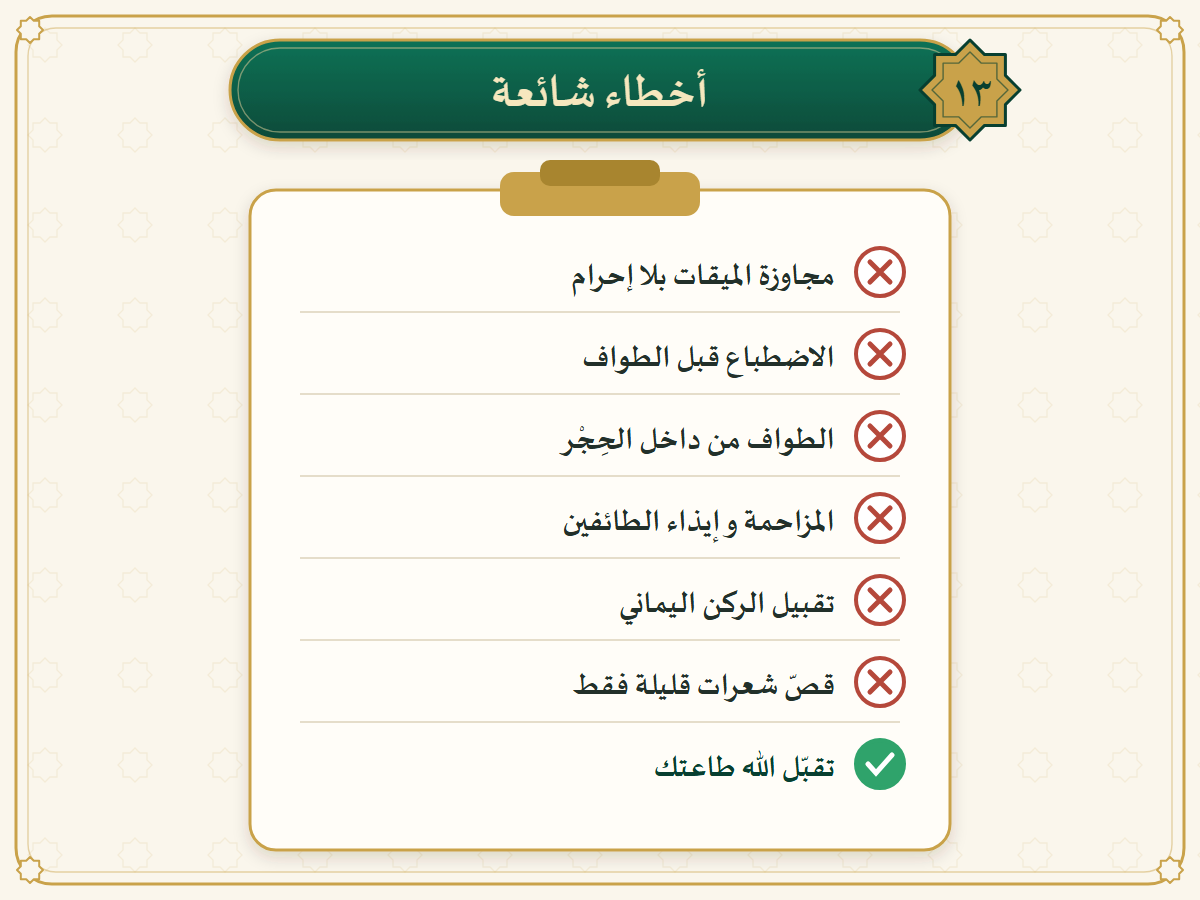
• Passing the miqat without entering ihram, including delaying it until Jeddah for those arriving by plane; whoever passes it must return and enter ihram from there; if one enters ihram from where they are, they must offer a sacrifice.
• Wearing the ihram garments from the time of entering ihram; the Sunnah is to wear them only during tawaf.
• Tawaf should be performed from within the Hijr Ishmael.
• Raise the hands at the Black Stone as they are raised in prayer; it is Sunnah to point with the right hand while saying the takbir.
• Kiss the Yemeni Corner, or touch the walls of the Kaaba and the Maqam Ibrahim.
• Severe crowding at the Black Stone and causing harm to other pilgrims.
• Dedicating each circuit to a specific written supplication, or reciting collective supplications aloud in a way that disturbs others.
• Repeating the verse ﴿إِنَّ الصَّفَا وَالْمَرْوَةَ...﴾ on every lap, when in fact it is recited only at the beginning of the Sa’i.
• Limiting oneself to cutting only a few strands of hair from the head; the correct practice is to shorten the hair all around.
We ask Allah to accept this from you, and to grant you a righteous ‘Umrah, a commendable Sa‘i, and forgiveness for your sins.
Sources
- صحيح البخاري وصحيح مسلم
- صحيح مسلم: حديث جابر في صفة حجة النبي ﷺ
- سنن أبي داود والترمذي وابن ماجه